The Fusion of Nature and Spirituality
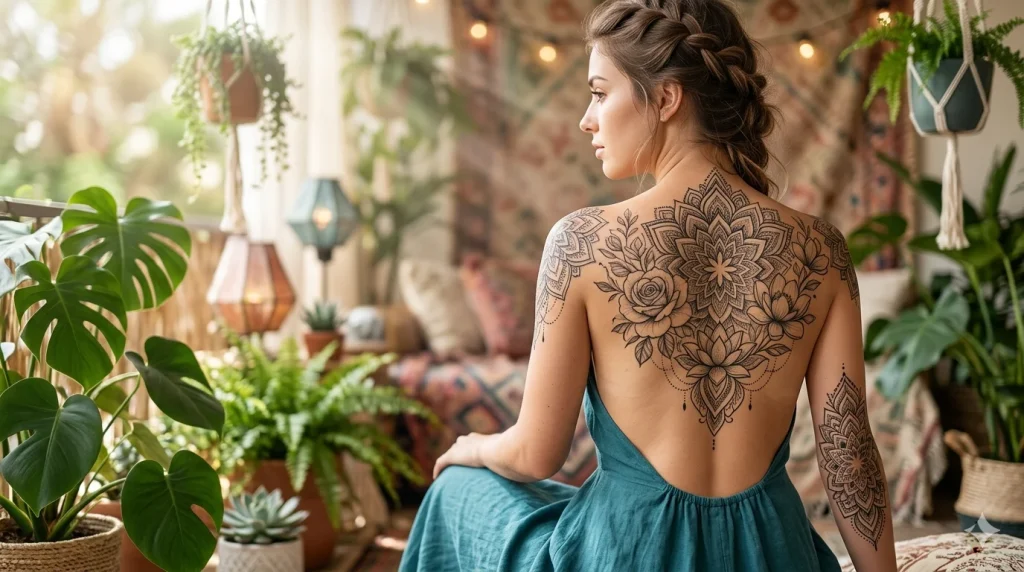
Within the realm of Floral & Feminine Designs, the Floral Mandala Tattoo stands as a breathtaking fusion of organic beauty and sacred geometry. Unlike standard flower tattoos that focus solely on botanical accuracy, floral mandalas integrate repetitive, symmetrical petals that radiate from a powerful center mirroring the structure of a blooming rose, lotus or daisy. This combination transforms a simple nature inspired piece into a spiritual diagram, representing the universe, wholeness and the cyclical nature of life. For the wearer, this means carrying a design that is not just decorative but deeply meditative, where every layered petal invites introspection and inner balance.
Intricate Detailing and Feminine Aesthetics
What sets these tattoos apart is their remarkable attention to intricate linework and dotwork, which creates a lace like, airy texture on the skin. The “floral” element softens the rigid precision of a traditional mandala, introducing gentle curves, stippled shading and negative space that feels inherently feminine and elegant. Common motifs include entwined vines, lotus pods, peonies or jasmine blooms, often embellished with fine dots along the outer edges to enhance the spiritual touch. Whether rendered in classic black ink for a timeless henna like effect or accented with muted watercolor tones like blush pink or sage green, this style complements the body’s natural contours gracefully adorning the ribcage, thigh, shoulder blade or spine with a sense of delicate strength.
Personal Meaning and Versatile Placement
Beyond their visual allure, Floral Mandala Tattoos carry rich symbolism tailored to the individual. The mandala’s center often represents the self or a core intention (such as growth, protection or compassion), while the unfolding floral layers signify expansion, fertility and the embrace of one’s feminine energy. This makes the design an ideal choice for marking a personal transformation, honoring a connection to nature or celebrating resilience. Thanks to their modular structure, these tattoos can scale from a small, subtle wrist accent to an elaborate back piece, always maintaining their spiritual essence. Ultimately a Floral Mandala Tattoo offers more than adornment it becomes a personal emblem of harmony, where the wildness of flowers meets the sacred order of the soul.
01. The Lotus Mandala Spine Tattoo
The Spiritual Anatomy of the Design
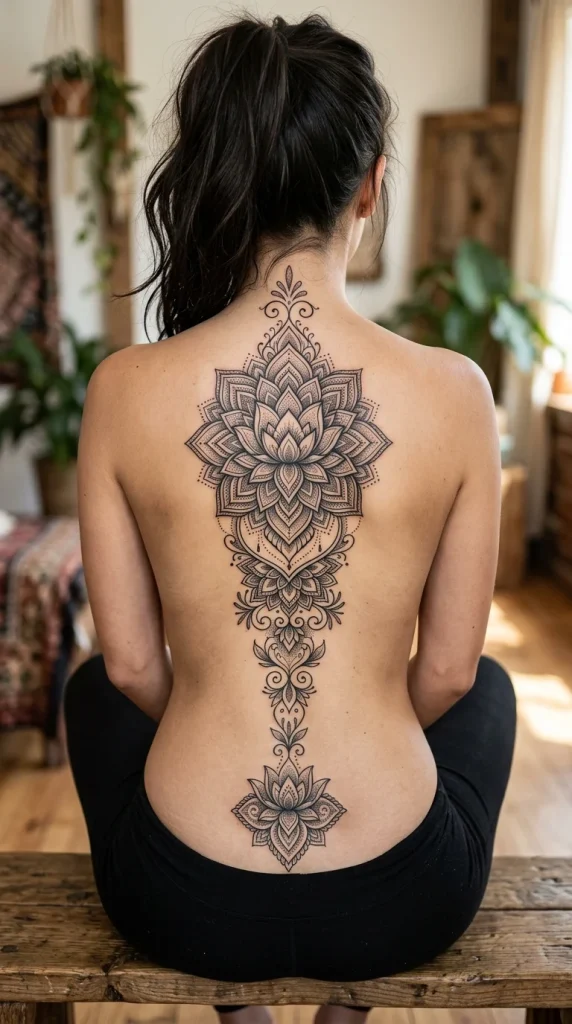
Within the Floral & Feminine universe, The Lotus Mandala Spine Tattoo represents one of the most spiritually potent placements imaginable. By aligning the sacred geometry of a mandala with the vertical axis of the spine often called the body’s “energy highway” in yogic and Eastern traditions this design transforms the back into a living meditation. The lotus flower, which grows from murky waters to bloom immaculately above the surface, serves as the central motif, symbolizing purity, rebirth and detachment from worldly struggles. When structured as a mandala, its petals radiate outward in perfect symmetry, echoing the chakras that run along the spine from root to crown. The result is not merely a tattoo but an energetic anchor, intended to remind the wearer of their inner resilience and spiritual ascent every time they catch a glimpse of their reflection.
Intricate Floral Geometry and Feminine Aesthetics
What makes this design unmistakably floral and feminine is the delicate interplay between structured mandala rings and organic lotus petals. Typically, the innermost layer features a closed lotus bud or a small circle representing the self. Surrounding it, two to three layers of lotus petals unfold each petal meticulously outlined with fine lines and adorned with subtle stippling or tiny dotwork to create a lace like, airy texture. The petals may be pointed (classic lotus) or softly rounded for a more romantic feel. Between the petal layers, artists often incorporate floral filler elements such as tiny jasmine blossoms, vine tendrils or even miniature daisies to soften the geometric edges. The entire composition narrows slightly toward the tailbone, following the spine’s natural curve and is usually executed in black or deep gray ink to preserve the henna like, elegant aesthetic. Some variations add muted watercolor accents think blush pink tips on the petals or a soft lavender glow behind the mandala without overpowering the intricate linework.
Placement, Pain and Personal Meaning
The spine placement is both a statement and a secret: the tattoo remains hidden under clothing, revealing itself only when the wearer chooses during a backless dress a swimsuit or an intimate moment of self admiration. This concealment adds to its spiritual purpose, making it a personal talisman rather than public display. Anatomically, the design typically spans from the upper back (around T1 – T2 vertebrae) down to the mid or lower back (L3 – L4), ranging from 8 to 14 inches in length. Pain levels are moderate to significant due to the spine’s proximity to bone and nerve endings but many wearers describe the sensation as “meditative” or “worth the discomfort for such meaningful placement.” Symbolically, each lotus layer can represent a life challenge overcome, a chakra balanced or a personal vow to grow. Some women add a tiny mantra such as “Om Mani Padme Hum” (the lotus mantra) or a single word like “Rise” hidden within the center petal. Ultimately, The Lotus Mandala Spine Tattoo is more than decoration; it is a wearable prayer for grace, strength and continuous blooming, placed exactly where your power resides.
02. Rose & Sacred Geometry Half Sleeve Tattoo
The Alchemy of Passion and Order
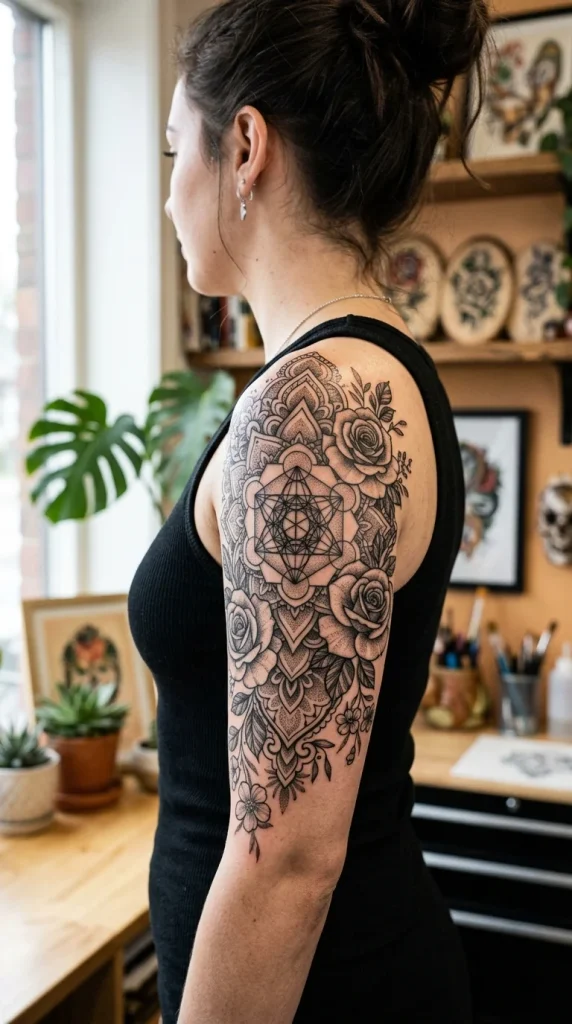
In the world of Floral Mandala Tattoos, the Rose & Sacred Geometry Half Sleeve stands as a powerful union between earthly desire and cosmic structure. The rose long associated with feminine passion, mystery and the heart’s deepest emotions finds itself woven into precise geometric patterns such as interlocking circles, hexagons or the Flower of Life. This juxtaposition creates a visual alchemy: the soft, organic curves of rose petals temper the rigid perfection of sacred shapes, while the geometry anchors the rose’s wildness into a harmonious mandala like flow. Wrapped around the forearm or upper arm, this half sleeve tells a story of balance reminding the wearer that true feminine strength lies not in chaos or control alone but in the graceful marriage of both. Spiritually, the design represents the integration of heart (rose) and mind (geometry), encouraging emotional healing through logical self awareness and vice versa.
Intricate Floral Geometry and Feminine Aesthetics
What elevates this half sleeve into a true work of art is its layered, wrap around composition that follows the natural contour of the arm. Typically, the design features a large central rose mandala on the outer forearm or bicep, where the rose’s spiral core expands into perfectly radiating petals, each outlined with fine, confident lines. Between these petals, sacred geometric shapes such as the Sri Yantra triangles, concentric circles or hexagonal honeycomb cells are interwoven, often filled with delicate dotwork stippling for a soft, feminine texture. Secondary elements include smaller rose buds, ivy vines or trailing jasmine that weave in and out of the geometric gaps, creating a sense of movement. The color palette can range from classic black ink (resembling intricate henna or etching) to more romantic tones: deep crimson or dusty rose for the petals, with gold or copper ink accents on the geometric lines. Negative space is used generously, giving the tattoo an airy, lace like quality that prevents it from feeling heavy or overwhelming a hallmark of feminine floral mandala design.
Placement, Flow and Personal Symbolism
The half sleeve placement whether on the forearm (from elbow to wrist) or upper arm (from shoulder to elbow) offers both visibility and intimacy. Forearm placement allows the wearer to see the design constantly, serving as a daily reminder of inner balance and self love; upper arm placement can be easily covered or revealed, ideal for professional settings. The tattoo typically wraps partially around the arm, leaving the inner arm or underside softer with minimal detail, which creates a beautiful three dimensional effect as you move. Pain is moderate, with sensitivity increasing near the elbow ditch and wrist bone but the result is a flowing, sculptural piece that feels like armor and jewelry combined. Symbolically, each element can be personalized: the rose may represent a specific love (self, family or a transformative relationship), while the geometric patterns can be chosen to reflect universal concepts the circle for wholeness, the triangle for manifestation or the hexagon for divine balance. Some women add hidden personal sigils, birth flowers or a meaningful date encoded in dotwork within the mandala’s center. Ultimately, the Rose & Sacred Geometry Half Sleeve is not just a tattoo it is a declaration that your heart’s passions are guided by wisdom and your spirit, like the rose, thrives within the sacred order of the universe.
03. Sunflower Chakra Mandala (Thigh or Shoulder) Tattoo
The Radiant Union of Solar Energy and Spiritual Alignment
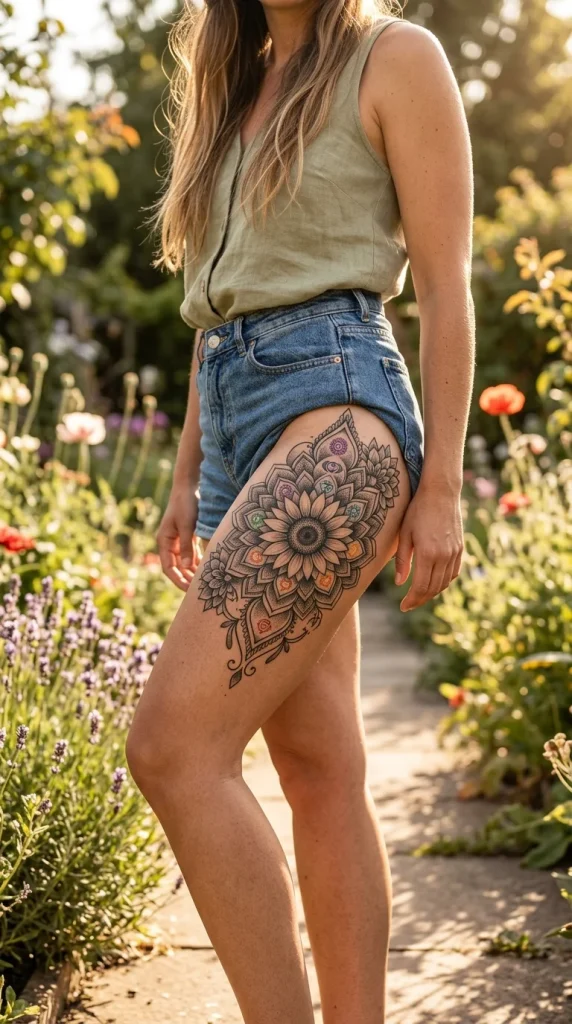
Within the Floral Mandala Tattoos sub category, the Sunflower Chakra Mandala stands as a vibrant celebration of joy, vitality and energetic harmony. The sunflower, with its unwavering gaze toward the sun, has long symbolized loyalty, abundance and the pursuit of light even in darkness. When fused with the chakra system, which maps the body’s seven energy centers from root to crown, this design becomes a powerful spiritual tool. Each layer of the mandala corresponds to a specific chakra: the outer ring of sunflower petals represents the root chakra (security and grounding), while moving inward, the geometric rings transition through the sacral, solar plexus, heart, throat, third eye and finally the crown chakra at the very center often depicted as a thousand petaled lotus or a brilliant sunburst. The result is a tattoo that acts as a visual affirmation of alignment, encouraging the wearer to live with radiance, purpose and an open heart.
Intricate Floral Geometry and Feminine Aesthetics
What makes this design unmistakably floral and feminine is the seamless integration of bold sunflower elements with delicate mandala detailing. The outermost ring features large, rounded sunflower petals, each meticulously outlined and lightly shaded with stippling or soft gradient strokes to mimic the velvety texture of real petals. Between these petals, tiny seed like dots or miniature daisy accents are often added, reinforcing the sunflower’s connection to abundance and fertility. Moving inward, the mandala rings become more intricate, incorporating geometric patterns such as concentric circles, lotus petal shapes or overlapping triangles (representing the Sri Yantra). Each ring is assigned a chakra color red, orange, yellow, green, blue, indigo and violet either through subtle watercolor washes, colored ink accents or carefully placed gemstone like dots. For a more subdued, feminine look, many choose black ink with selective color only in the chakra centers (e.g., a tiny ruby dot for root an amethyst dot for crown). The design is often framed by additional floral elements like trailing vines, marigolds or chamomile blossoms that soften the geometric edges and enhance the organic feel.
Placement, Energy Flow and Personal Empowerment
The dual placement options thigh or shoulder offer distinct energetic and aesthetic benefits. On the thigh, the sunflower chakra mandala occupies a large, curved canvas, allowing the design to be expansive (6 to 10 inches in diameter). This placement is deeply connected to the root and sacral chakras, making it ideal for grounding and creative energy. The thigh also offers the wearer the choice of concealment or revelation, perfect for someone who wants their spiritual tattoo to be a private source of strength. On the shoulder (specifically the shoulder cap or deltoid), the mandala sits close to the heart and throat chakras, emphasizing self expression and compassion. This smaller, rounded placement (4 to 6 inches) creates a beautiful, badge like effect that pairs well with off the shoulder tops or sleeveless dresses. Pain levels are low to moderate on both locations, with the outer thigh being one of the least painful spots and the shoulder cap being mildly sensitive near the bone. Symbolically, each chakra ring can be personalized: some women replace the standard chakra colors with their own birthstone colors or they add a meaningful mantra in Sanskrit or English within the center circle. A powerful addition is to have the sunflower petals numbered seven, fourteen or twenty one each representing a life lesson or a person who brought light into the wearer’s life. Ultimately, the Sunflower Chakra Mandala is more than a tattoo; it is a daily reminder to turn toward your own inner sun, to bloom where you are planted and to honor the luminous energy centers that make you beautifully, powerfully alive.
04. Wildflower Dotwork Mandala (Ribcage or Hip) Tattoo
The Beauty of Imperfection and Untamed Feminine Energy
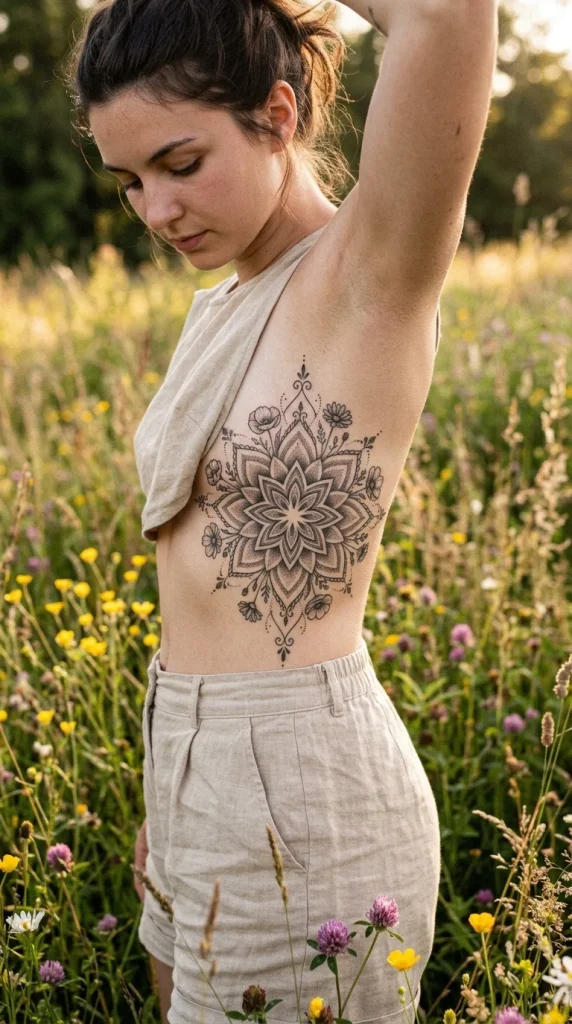
Within the Floral Mandala Tattoos sub-category, the Wildflower Dotwork Mandala offers a refreshing departure from perfect symmetry and rigid geometry. Where traditional mandalas emphasize precise circles and mathematical balance, this design embraces the organic, asymmetrical beauty of wildflowers growing freely in a meadow. The mandala structure remains present a soft, implied circle created through radiating dotwork and scattered blooms but it is intentionally loose, breathable and forgiving. Wildflowers such as lavender, poppy, cornflower, chamomile and yarrow are arranged not in perfect repetition but in a natural, almost wind swept radial pattern. This design celebrates the untamed feminine: the woman who is not afraid to be complex, slightly unpredictable and deeply connected to the earth. Spiritually, the wildflower mandala represents freedom from perfectionism, resilience in harsh conditions (wildflowers thrive where cultivated flowers cannot) and the quiet beauty of growing exactly as you are without apology.
Intricate Dotwork and Soft, Airy Aesthetics
What makes this tattoo truly distinctive is its heavy reliance on stippling (dotwork) rather than solid lines or dense shading. Thousands of tiny black or deep gray dots are meticulously placed to create gradients, shadows and texture, giving the entire composition a soft, ethereal, almost watercolor like appearance without using any color. The wildflower petals are outlined with fine, broken lines that fade into dotwork, mimicking the delicate, slightly fuzzy edges of real wildflowers. Lavender spikes are built from vertical rows of dots; poppy petals feature dense stippling near the center that gradually disperses toward the edges; cornflowers are rendered as clusters of tiny dot-circles. Between the flowers, negative space is treated as part of the design breathing room that prevents the tattoo from feeling heavy or cluttered. The overall effect is lace like, airy and deeply romantic. For those who wish to add a whisper of color, muted tones like dusty lavender, sage green or soft coral can be lightly washed over certain blooms but the design remains most powerful in pure black dotwork, where the contrast between dense stipple and bare skin creates a luminous, glowing quality.
Placement, Sensuality and Personal Meaning
The ribcage and hip placements are among the most intimate and sensual locations for any tattoo, making the Wildflower Dotwork Mandala a deeply personal talisman. On the ribcage, the design typically curves along the lower ribs, following the body’s natural lines from just under the breast down toward the waist. This placement stretches and moves beautifully with breath, making the flowers appear to sway and dance as you inhale and exhale a poetic reminder to breathe through life’s challenges. Pain on the ribcage is significant (moderate to high) due to thin skin and bone proximity, but many describe it as an empowering rite of passage. On the hip, the mandala can wrap over the hip bone, extending slightly onto the lower belly or outer thigh. This placement celebrates the curves of the female body, with the wildflowers following the natural dip and rise of the pelvis. Pain is lower on the fleshy outer hip, increasing near the bone. Symbolically, wildflowers can be chosen for their personal meanings: lavender for calm and devotion, poppy for remembrance and imagination, cornflower for delicacy and hope, chamomile for patience and resilience. Some women add a few scattered dots drifting away from the main design, like seeds floating on the wind representing intentions released into the universe or loved ones who have passed but remain present. Ultimately, the Wildflower Dotwork Mandala is not a tattoo of rigid perfection; it is a tattoo of becoming. It says: I am growing exactly where I am planted. I am soft but unbreakable. And my beauty is not in my symmetry but in my truth.
05. Peony & Moon Phase Mandala (Back of Neck or Wrist) Tattoo
The Sacred Dance of Blooming and Becoming
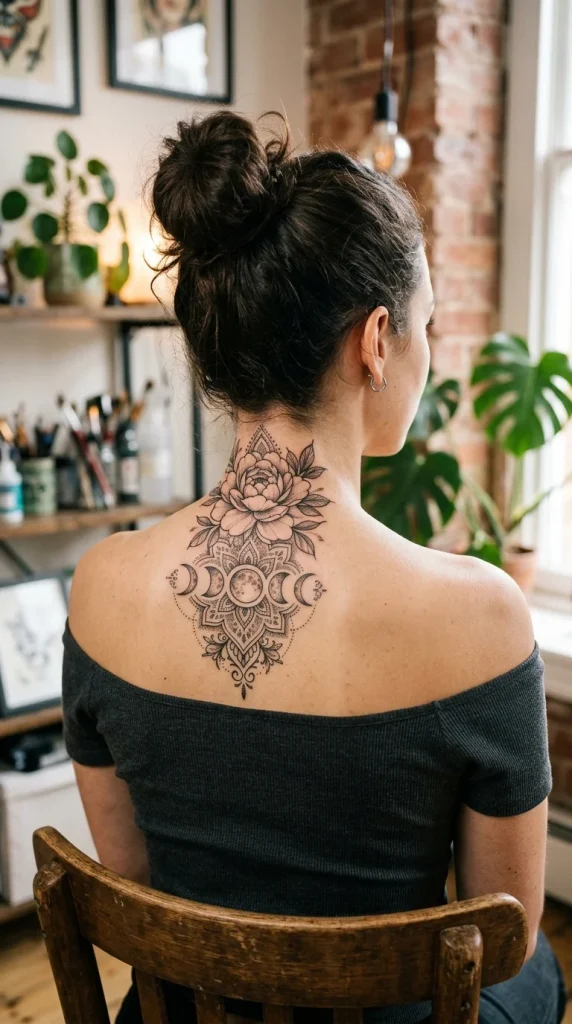
Within the Floral Mandala Tattoos sub-category, the Peony & Moon Phase Mandala represents one of the most intimate and poetic designs, weaving together two powerful feminine symbols: the lush peony and the cycling moon. The peony, often called the “queen of flowers” in Eastern traditions, symbolizes romance, prosperity, honor and the soft yet fierce beauty of womanhood. When paired with the moon phases new, crescent, half, gibbous and full this mandala becomes a meditation on cycles: of nature, of the body, of emotions and of personal transformation. The mandala structure holds these elements together in a compact, circular composition, with the peony’s layered petals radiating outward from a central point (often a full moon or a single seed), while the moon phases orbit around the outer edge like celestial guardians. Spiritually, this tattoo honors the ever changing nature of feminine existence the understanding that just as the moon wanes and waxes and the peony blooms then retreats, women are not meant to be constant or predictable. Instead, they are meant to flow, to rest, to expand and to contract all while remaining whole.
Delicate Floral Geometry and Dainty Feminine Aesthetics
What makes this design unmistakably floral, feminine and mandala like is its refined balance between soft botanical shapes and precise celestial geometry. The peony at the center is rendered with remarkable detail despite the small canvas: layered, ruffled petals that overlap like silk ribbons, each petal outlined with whisper thin lines and lightly shaded with stippling or soft gray washes to create volume and depth. Unlike a traditional full sized peony tattoo, this miniature version often features simplified petal counts (five to seven layers) to maintain clarity. Surrounding the peony, the first mandala ring may consist of tiny dots or seed like shapes, representing potential and growth. The outer ring features the moon phases typically four to eight small crescents and circles arranged in sequence, often connected by delicate geometric lines or a thin unbroken circle that acts as a frame. Some designs incorporate additional floral accents such as tiny cherry blossoms, star jasmine or even a single falling petal to enhance the sense of gentle motion. The color palette is almost always kept soft and subdued: black or deep charcoal gray for the linework and dotwork, with optional subtle hints of blush pink, dusty rose or lavender on the peony petals. For an even more ethereal look, some women choose a “single needle” technique, where the entire tattoo is executed with an ultra fine needle, resulting in a design that resembles delicate embroidery or a vintage illustration.
Placement, Visibility and Personal Lunar Rituals
The back of neck and wrist placements are among the most visible yet dainty locations for a mandala tattoo, each offering a different relationship with the wearer. On the back of the neck, the Peony & Moon Phase Mandala sits at the base of the hairline, often partially hidden by loose hair and revealed when the wearer wears an updo or a cropped hairstyle. This placement is intimately connected to the throat chakra and the “soft spot” of vulnerability, making the tattoo a quiet source of protection and self expression. The design is typically oriented upright, with the peony facing outward so others can admire it or facing downward toward the spine for a more private, personal meaning. Pain is low to moderate as the back of the neck has thin skin but fewer nerve endings than the front of the body. On the inner wrist, the mandala becomes a daily companion visible every time the wearer checks the time, writes or gestures. This placement aligns with the pulse point, making the tattoo a living connection between the moon’s gravitational pull (which affects tides and bodies) and the wearer’s own heartbeat. Pain on the wrist is mild to moderate, with sensitivity near the tendons. Symbolically, each moon phase can be personalized to represent significant dates in the wearer’s life: a new moon for a birth or fresh start a full moon for a moment of peak joy or realization a waning moon for a release or letting go. Some women align the moon phases with their own menstrual cycle or use the tattoo as a meditation anchor during lunar rituals. A meaningful addition is to place a tiny dot or star at the center of the peony, representing the wearer’s own inner light constant even through all phases of change. Ultimately, the Peony & Moon Phase Mandala is more than a tattoo; it is a wearable lunar calendar a celebration of cyclical femininity and a quiet promise to honor every version of yourself budding, blooming, resting and renewing again and again.