The Essence of Movement and Grace
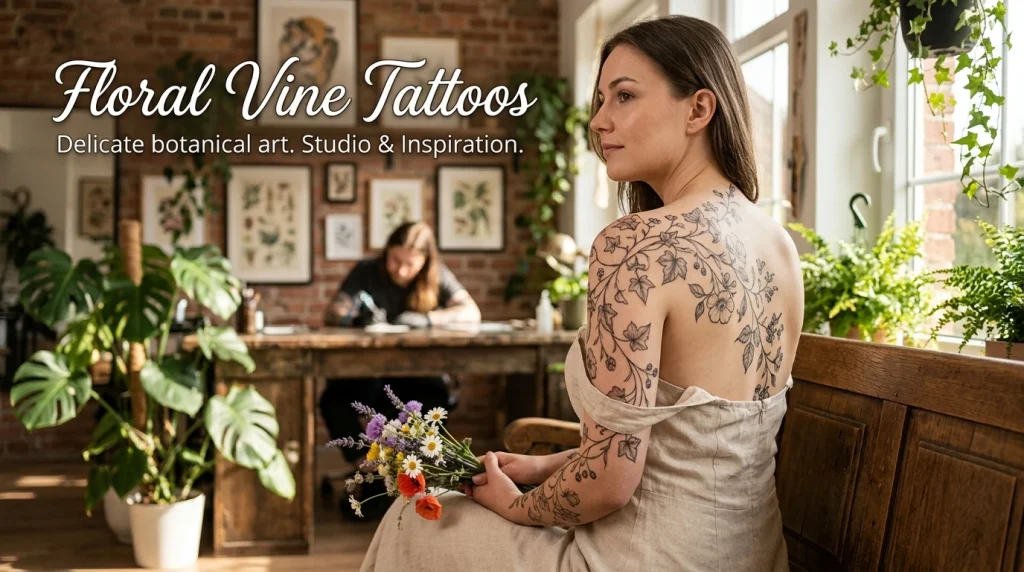
Within the realm of Floral & Feminine Designs, Floral Vine Tattoos stand out as the ultimate expression of organic movement. Unlike static, centered pieces, these tattoos are defined by their flowing, wrap around nature designed to follow the natural contours of the human body. Whether spiraling up an ankle, curling over a shoulder or trailing along a forearm, the vine acts as a living ribbon that accentuates the wearer’s anatomy. This style transforms the skin into a trellis, where delicate stems twist and turn, creating an illusion of gentle growth that feels both spontaneous and intentional.
Botanical Details and Feminine Symbolism
What makes these designs distinctly feminine is their emphasis on soft, intricate details and layered symbolism. The vine itself often represents connection, resilience and the winding journey of life, while the blossoms attached to it such as roses for passion, lilies for purity or cherry blossoms for fleeting beauty add personal narrative. Artists enhance the femininity through techniques like fine line work, stippled shading and negative space leaves, which keep the pattern airy rather than heavy. Common placements include wrapping around the ribs, curling up the thigh or trailing from the hip to the lower back, turning each tattoo into a custom fit accessory that celebrates softness without losing strength.
Versatility in Style and Scale
A major advantage of floral vine tattoos is their remarkable versatility. They can exist as minimalist, single line outlines for a subtle whisper of nature or evolve into lush, watercolor masterpieces with splashes of emerald, lavender or blush pink. For a bold, feminine statement, some choose to integrate small elements like berries, ferns or even tiny butterflies nestled among the leaves. Because the pattern wraps and flows, it can easily be extended over time starting as a small wrist vine and growing into a full sleeve. This adaptability ensures that whether you prefer dainty, whimsical styles or dramatic, dark floral realism, the wrap-around botanical pattern remains a timeless choice for anyone seeking a tattoo that moves with them, both physically and emotionally.
01. The Wrist to Elbow Trailing Rose Vine
A Signature of Delicate Movement
Among the most beloved expressions of the Floral Vine Tattoos sub-category, The Wrist to Elbow Trailing Rose Vine stands as a quintessential choice for those seeking understated elegance with a dynamic, flowing quality. As the name suggests, this design begins softly at the inner wrist often with a tiny, unopened bud or a single small leaf and then winds diagonally around the forearm, finally resting just below the elbow crease with one or two fully bloomed roses. What makes this piece distinctly feminine is its graceful trajectory: the vine never sits statically; instead, it spirals gently across the wrist bone, disappears behind the forearm and reappears on the outer side, creating a continuous ribbon-like effect that accentuates the natural turn of the arm. This wrap-around movement transforms a simple botanical pattern into a living accessory that shifts beautifully with every gesture, wave or reach.
Botanical Storytelling Through Details
The true charm of the Wrist to Elbow Trailing Rose Vine lies in its careful balance of softness and structure. The roses themselves carry deep symbolic weight red for passionate love, pink for gentle admiration or white for new beginnings allowing the wearer to personalize the narrative. A typical composition includes two to three roses of varying sizes: a small bud near the wrist suggesting potential a half opened bloom in the mid forearm representing growth and a fully flourished rose at the elbow symbolizing fulfillment. Surrounding these flowers are delicate, tapered leaves with softly serrated edges, often rendered in fine-line black ink or muted sage green. To maintain the feminine aesthetic, most artists omit sharp thorns or reduce them to subtle, barely there bumps. Stippled shading (tiny dots) around the petals and leaf veins adds depth without heaviness, while negative space gaps between vine segments keep the design airy and breathable essential for a tattoo that wraps rather than clutters the skin.
Versatility, Placement and Customization
One of the greatest advantages of this specific vine design is its remarkable adaptability to different arm shapes, skin tones and personal style preferences. On a slender wrist, the vine can remain thin and minimalist executed in a single continuous gray line with no shading for a whisper light effect. On a fuller forearm, the same design can be widened with additional leaves, secondary tendrils or even tiny accompanying elements like baby’s breath flowers, small berries or a hovering butterfly. The wrap around nature also allows for easy future extensions: the vine can continue upward into a full sleeve or a matching second vine can be added to the other arm for symmetry. Color options range from classic black and gray realism to soft watercolor washes in blush pink, dusty rose or deep crimson. For an extra feminine touch, some artists incorporate gold ink dots at the rose centers or tiny dewdrop highlights on select petals. Placement is equally flexible while the standard version runs along the inner to outer forearm a popular variation shifts the vine to the top of the forearm (the “sunny side”) for a more visible, bolder statement or winds it strictly along the inner arm for a more intimate, hidden gem effect. Regardless of the choices made, this trailing rose vine remains a timeless celebration of floral grace, personal growth and the beauty of motion.

02. The Ribcage to Hip Winding Jasmine Vine
Sensuous Flow Along the Female Silhouette
Within the Floral Vine Tattoos sub category, The Ribcage to Hip Winding Jasmine Vine represents one of the most intimate and body conscious designs available. Unlike vine tattoos that wrap around limbs, this piece is specifically choreographed to follow the natural curves of the female torso beginning near the underbust or lower ribs, dipping gracefully along the side of the ribcage and finally curling to rest on the prominent bone of the hip. What makes this design exceptionally feminine is its ability to mirror the body’s own rhythms: the vine rises and falls with each breath, stretches subtly with movement and draws the eye along the waist’s narrowest point before widening toward the hip. This wrap around effect is partial rather than complete the vine hugs the side of the torso like a gentle embrace, never fully circling the body but instead creating a crescent shaped botanical trail that feels organic, sensual and elegantly understated.
The Language of Jasmine and Lightness
The choice of jasmine as the primary floral element elevates this design with rich symbolic meaning and a distinctively airy aesthetic. In many cultures, jasmine represents purity, sensuality, divine hope and the beauty of the night as jasmine flowers often release their sweetest fragrance after sunset. Each blossom in the vine is typically small (roughly the size of a thumbnail), star-shaped with five delicate petals and clustered in groups of two or three along a thin, flexible stem. To maintain a feminine and ethereal quality, most artists render jasmine flowers with no outlines or ultra fine single lines, using soft gray washes or pale white ink against skin to create a “glowing” effect. The leaves are equally refined: small, oval and opposite each other along the vine, often stippled or left as negative space outlines. A signature detail of this design is the inclusion of tiny unopened buds scattered among the blooms, suggesting continued growth and quiet anticipation. The winding path itself tells a story starting tentatively near the ribs, gaining confidence across the torso, and finally blooming fully at the hip, symbolizing a journey toward self assurance and embodied femininity.
Placement Nuances and Styling Variations
The Ribcage to Hip Winding Jasmine Vine offers remarkable customization while demanding careful attention to placement due to the torso’s complex topography. The most classic version begins approximately two inches below the underbust (or just above the natural waistline), follows the oblique muscles in a gentle S curve and ends with a small flourish of three full blossoms on the anterior hip bone. For a more dramatic wrap around effect, the vine can start near the spine on the back, curl around the side of the ribs and continue to the front hip creating a true 180 degree flow. Women who prefer greater discretion often choose a shorter version that stays entirely along the lower ribs, visible only when raising an arm or wearing a cropped top. Styling options range from minimalist fine line black ink (ideal for a first tattoo) to soft gray wash realism or even a subtle watercolor approach using pale cream, soft yellow or lavender tones for the jasmine petals. Additional feminine elements can be woven in, such as tiny silver moon phases nestled among the leaves a scattering of floating petals trailing behind the main vine or a single dewdrop rendered in white ink on the largest bloom. Due to the sensitive nature of the ribcage area, this design is typically executed over two to three sessions for larger compositions, allowing time for healing and for the wearer to live with the vine’s flow before adding final details. The result is a tattoo that feels less like ink on skin and more like a secret garden permanently in bloom along the body’s most graceful curve.

03. The Ankle to Calf Climbing Ivy Wrap
Grounded Elegance That Climbs With You
Within the Floral Vine Tattoos sub category, The Ankle to Calf Climbing Ivy Wrap offers a uniquely grounded yet ascending form of botanical body art. Unlike vine designs that begin at the wrist or ribcage, this piece starts at the most foundational point of the body the outer ankle bone and then climbs upward in a determined spiral, wrapping around the lower leg twice before settling at the mid calf. What makes this design distinctly feminine is its dual personality: from the ankle, it reads as delicate and almost jewelry like, hugging the bony prominence with tiny, heart shaped leaves; as it ascends toward the calf, the vine gradually widens and becomes more lush, symbolizing growth, resilience and quiet strength. The wrap around effect is continuous and complete the ivy visually disappears behind the Achilles tendon, crosses the shin diagonally and reappears on the inner calf, creating the illusion of a living plant that has genuinely taken root around the wearer’s leg.
The Symbolism and Structure of Ivy
Ivy is a particularly meaningful choice for a feminine tattoo, carrying centuries of symbolic weight that aligns beautifully with personal narratives of endurance and devotion. In ancient Greco Roman tradition, ivy was sacred to Dionysus and represented everlasting fidelity, partly because the plant remains green even through winter. In Victorian floriography, ivy conveyed marriage, friendship and undying attachment qualities that many modern wearers appreciate for commemorating long term relationships, family bonds or personal commitments to self growth. Botanically, the ivy vine in this design is characterized by its distinctive five lobed leaves (similar in shape to a star or a hand) that alternate along a slender, slightly twisting stem. To maintain a feminine aesthetic, most artists render the leaves in soft, rounded forms rather than sharp or aggressive angles, often using stippled shading or fine parallel lines to suggest veining without heaviness. A signature feature of the climbing ivy wrap is the inclusion of small, dark berry clusters usually placed near the calf endpoint which add visual contrast and a touch of autumnal richness. Some variations omit the berries entirely for a cleaner, more minimalist look, while others incorporate tiny winding tendrils that curl away from the main vine like delicate question marks, emphasizing the plant’s searching, climbing nature.
Placement Nuances, Symmetry and Styling Options
The Ankle to Calf Climbing Ivy Wrap is uniquely suited to the lower leg’s anatomy, offering both visibility and versatility depending on footwear and hemline choices. The classic placement begins precisely at the lateral malleolus (the bony bump on the outside of the ankle), wraps behind the Achilles tendon, crosses the front shin just below the mid point, and completes a second spiral that ends two to three inches below the back of the knee. For a more dramatic effect, some wearers choose a “double wrap” that circles the leg three full times, creating a stacked, ivy covered look reminiscent of an ancient column. A particularly feminine variation involves mirroring the design on both legs identical vines that climb in parallel or in opposite directions (one clockwise, one counter clockwise) for a balanced, harmonious appearance. Styling options range from crisp black and gray fine line work (ideal for showcasing the leaf shapes without distraction) to soft green watercolor washes in sage, olive or moss tones. Those seeking an ethereal, almost magical aesthetic sometimes request tiny white ink highlights on individual leaves or a scattering of glowing “spores” or stars drifting upward from the vine tips. Due to the natural curves of the calf and ankle, this design moves beautifully with the wearer the leaves shift and separate during walking, the vine stretches slightly when pointing the toes, and the overall composition remains visible in sandals, skirts or cropped pants. Whether chosen as a standalone piece or as the beginning of a larger botanical leg sleeve, the climbing ivy wrap transforms the lower leg into a story of persistence, quiet beauty and the gentle power of putting down roots while still reaching higher.

04. The Shoulder to Wrist Cascading Cherry Blossom Vine
Effortless Drama From Shoulder to Fingertip
Within the Floral Vine Tattoos sub-category, The Shoulder to Wrist Cascading Cherry Blossom Vine represents the most expansive and visually dramatic option, transforming the entire arm into a flowing river of petals. Unlike tighter wrap designs that spiral closely around a limb, this vine cascades meaning it drapes loosely over the shoulder cap, flows down the outer arm with gentle dips and rises and gradually tapers toward the wrist, where individual petals appear to float away from the main stem. What makes this design exceptionally feminine is its airy, almost weightless quality: the cherry blossom branches are thin and dark (often rendered in rich brown or charcoal gray), while the blossoms themselves cluster in soft pinks and whites, creating a high contrast composition that feels both bold and ethereal. The cascading effect mimics the natural growth habit of weeping cherry trees, where blossoms seem to tumble downward in a celebratory shower, making this tattoo a perfect choice for anyone who wants their ink to capture a sense of joyful motion, seasonal beauty and gentle impermanence.
The Poetic Symbolism of Cherry Blossoms
The cherry blossom or sakura, is one of the most emotionally resonant flowers in botanical tattoo art, carrying profound feminine symbolism rooted in East Asian philosophy. At its core, the cherry blossom represents mono no aware a Japanese term meaning the bittersweet awareness of impermanence. The blossoms bloom spectacularly for only one week each year, then fall like pink snow, reminding wearers to cherish beauty, youth and fleeting moments of happiness. For women specifically, sakura also symbolizes feminine strength, renewal and the courage to bloom fully even knowing that all things must pass. In this cascading vine design, the blossoms are typically rendered in clusters of three to five flowers, each with five delicate notched petals and fine visible stamens ending in tiny dots. Some artists include half open buds and newly sprouted leaves (a coppery brown color) to represent the cycle of life, while others focus entirely on full blooms mixed with falling petals to emphasize transience. To maintain a distinctly feminine aesthetic, the branches are kept slender and graceful never thick or heavy often drawn with slight curves and calligraphic brush stroke energy. A signature detail of this design is the “petal trail”: a scattering of individual blossoms and single petals that detach from the main vine and drift downward toward the wrist, some overlapping and some floating independently, creating the illusion of a gentle breeze caught in time.
Full Arm Flow, Placement Variations and Styling Choices
The Shoulder to Wrist Cascading Cherry Blossom Vine is uniquely suited to the arm’s length and contours, offering multiple placement variations depending on how much coverage and visibility the wearer desires. The classic full arm version begins on the top of the shoulder (sometimes extending slightly onto the collarbone or upper back), drapes over the deltoid muscle, follows the outer bicep, crosses the elbow ditch loosely (or avoids it entirely for comfort), then continues along the outer forearm to end just above the wrist bone. For a more subtle approach a “half cascade” version starts at the elbow instead of the shoulder, making it easier to conceal under sleeves while still offering dramatic flow. A particularly romantic variation positions the vine along the inner arm, so the blossoms are visible only when the arm is raised or turned creating an intimate, secret garden effect. Styling options are remarkably diverse: traditionalists may prefer black and gray with soft shading, while those seeking maximum femininity often choose watercolor pinks (from pale blush to deep cherry blossom rose) with no outlines on the petals for a painterly, translucent look. Some artists incorporate gold leaf accents, tiny dewdrops in white ink or even a crescent moon nestled among the upper branches for a celestial touch. The vine can also be extended into a full chest and arm composition, with branches crossing the collarbone and meeting a matching vine on the opposite shoulder. Due to the design’s length and detail level, this tattoo is typically completed over two or three sessions, allowing the artist to layer the petal clusters and perfect the cascading flow. Whether worn as a bold statement sleeve or a delicate whisper of seasonal beauty, the cherry blossom cascade transforms the arm into a living reminder that the most beautiful things in life are also the most fleeting and therefore the most precious.

05. The Thigh to Knee Wrapping Lily & Fern Combo
Bold Grace Across the Largest Canvas
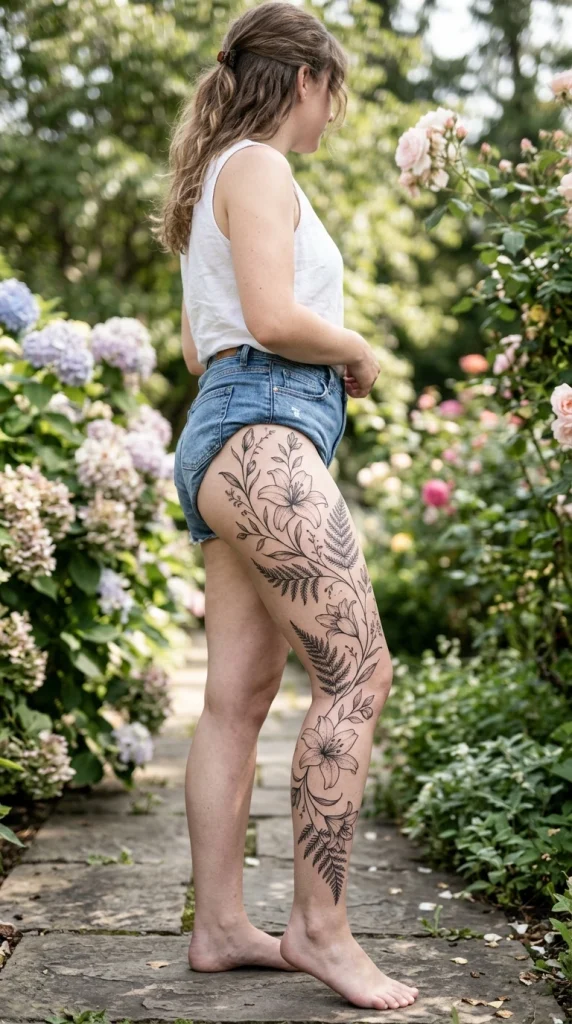
Within the Floral Vine Tattoos sub-category, The Thigh to Knee Wrapping Lily & Fern Combo stands as a powerful yet graceful statement piece, utilizing the thigh’s generous surface area to create a truly immersive botanical experience. Unlike vine designs that remain narrow and delicate, this composition combines two distinct plant forms the bold, architectural lily and the soft, feathery fern into a single flowing wrap that begins on the upper outer thigh, spirals diagonally across the front and tapers to end just above or behind the knee. What makes this design distinctly feminine is its juxtaposition of strength and softness: the lilies command attention with their large, trumpet shaped blooms and prominent stamens, while the ferns provide an airy, lacy counterbalance that softens the overall silhouette. The wrap around effect is particularly dramatic on the thigh as the vine widens like a teardrop thinner near the hip, expanding to its fullest just above the knee and then narrowing again creating a composition that naturally accentuates the leg’s curves and draws the eye downward in a flattering, elongating gesture.
The Symbolic Power of Lily and the Delicacy of Fern
The combination of lily and fern in a single vine creates a rich layered narrative as each plant carries its own distinct feminine symbolism that complements and enhances the other. The lily, in its many color variations, represents refined beauty, purity and transition white lilies speak to majesty and virtue, pink lilies to prosperity and admiration and orange lilies to passionate confidence. The flower’s dramatic, recurved petals and exposed stamens (often tipped with deep amber or rust colored anthers) convey a sense of bold, unapologetic femininity that refuses to be overlooked. By contrast, the fern brings an entirely different energy: delicate, ancient and quietly resilient. In Victorian floriography, ferns symbolized sincerity, magic and the bonds of deep trust. Their feathery, repeating fronds create a textural backdrop that makes the lilies pop while adding a sense of woodland whimsy. To maintain a cohesive feminine aesthetic, most artists render the lily petals with soft gradients or stippled shading rather than harsh outlines, while the fern fronds are executed in fine, parallel lines that curl inward at the tips. A signature detail of this combo is the way the vine transitions thicker, smoother stems for the lilies that gradually branch into the wiry, almost calligraphic stems of the ferns, suggesting a seamless partnership between two very different forms of botanical beauty.
Thigh Anatomy, Wrap Variations and Styling Depth
The Thigh-to-Knee Wrapping Lily & Fern Combo is uniquely suited to the leg’s largest muscle group, offering multiple compositional approaches depending on the wearer’s desired level of visibility and drama. The classic placement begins on the upper outer thigh (approximately four inches below the hip bone), wraps diagonally across the front of the thigh, and spirals to the inner or back of the knee creating a true 180 degree wrap that is visible from multiple angles. For a more elongated, leg lengthening effect, some wearers choose a front-only version that runs straight down the center of the thigh, with the vine widening into an oval or teardrop shape just above the knee. A particularly sensual variation positions the vine along the outer thigh only, curving to follow the natural line of the leg from hip to knee, which looks stunning when wearing side slit skirts or high cut swimwear. Styling options range from bold black and gray realism (where the lilies are heavily shaded for dramatic contrast) to soft watercolor in cream, blush, sage and dusty rose tones. Those seeking an ethereal, almost pre Raphaelite aesthetic sometimes request subtle color shifts within the lily petals pale pink fading to ivory at the edges while the ferns remain in muted greens or even soft gray. Additional feminine elements can be woven in, such as tiny glowing fireflies hovering near the blooms a scattering of fern spores rendered as delicate dots or a hidden meaningful symbol (a name, date or small heart) tucked into the curl of a frond. Due to the thigh’s size and the detail required for realistic lilies and ferns, this design typically requires two to three sessions, allowing for careful layering of petals and fronds. Whether worn as a standalone masterpiece or as the centerpiece of a larger botanical leg sleeve, the lily and fern combo transforms the thigh into a celebration of confident femininity bold enough to be seen, soft enough to feel like a secret garden in bloom.