
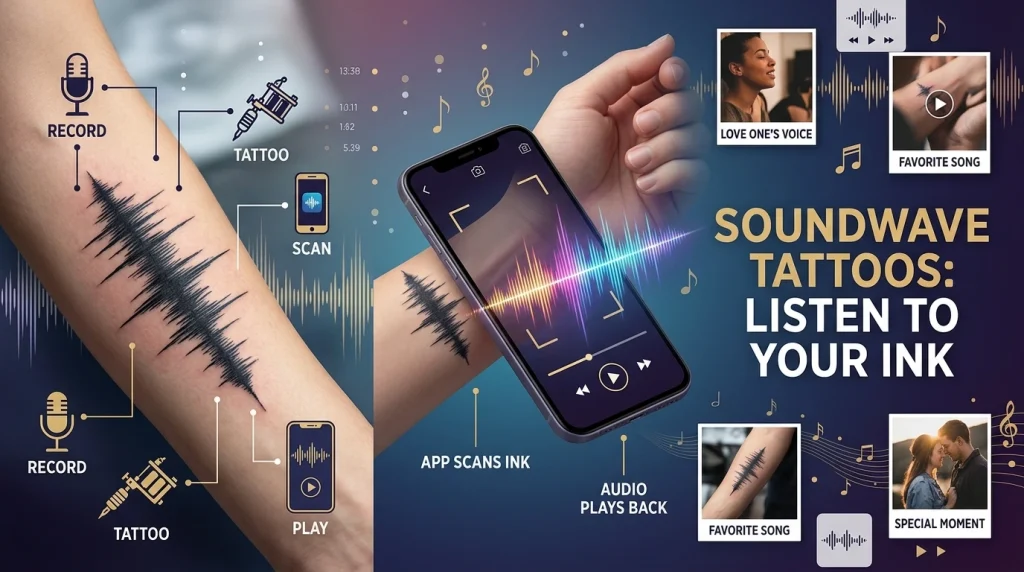
The Concept and Technical Execution
Soundwave Tattoos represent a radical shift from traditional imagery, anchoring body art in the invisible dimension of sound. Unlike a standard portrait or lyric quote, this experimental ink captures the actual visual oscillogram of a specific audio clip whether it’s a loved one saying “I love you,” a baby’s first laugh or the drop from a favorite song. Using specialized software, the audio waveform is mapped onto the skin as a series of precise, vertical peaks and valleys. What makes this truly innovative is the functional integration with modern smartphones; when a client scans the tattoo using a dedicated augmented reality (AR) app, the unique shape of that soundwave triggers the audio file, allowing the skin to literally “play” the recorded message.
Artistic Challenges and Customization
As a form of experimental ink, Soundwave Tattoos push the boundaries of both artistry and technical precision. The artist must balance aesthetic appeal with digital functionality waveforms that are too shallow may not be scannable, while those too deep can blur over time, corrupting the audio link. To combat this, innovators in the field use fine line single needle techniques, often placing the design on hairless, flat areas like the inner forearm, ribs or behind the ear. Clients can customize the visual style further by integrating the black waveform into a larger composition such as having the peaks morph into a mountain range a heartbeat line or being wrapped by song lyrics creating a hybrid piece that is part data portal, part fine art.
Emotional Impact and Future Potential
Beyond the technical novelty, Soundwave Tattoos redefine the emotional permanence of body art. While a traditional tattoo holds static memory a soundwave tattoo holds a dynamic, living recording. This innovation allows a grieving person to literally carry a deceased parent’s voice on their wrist or a couple to encode their wedding vows into a bracelet like band. The experimental nature also points toward future applications, such as multi layered soundwaves that play different tracks depending on the scan angle or color coded frequencies that visualize musical genres. In essence, this category of ink transforms the body from a simple canvas into an interactive audio archive proving that in the world of experimental tattoos, seeing is no longer believing; hearing is.
01. The “Hidden Locket” Soundwave Tattoos
The Concept of Camouflaged Audio
The “Hidden Locket” Soundwave redefines the relationship between visibility and secrecy in body art. Unlike standard soundwave tattoos, which openly display a waveform as a stark, scientific line, this experimental design hides the audio data within a recognizable, decorative object such as a vintage locket an envelope a folded rose or an open book. To the casual observer, the tattoo appears to be a delicate, romantic illustration. However, embedded within the lines of that object is a fully functional soundwave, shaped to mimic a ribbon, a crease a stem or the edge of a photograph. This fusion of sentimental imagery with digital audio technology allows the wearer to carry a private voice message or song in plain sight, accessible only to those who know the secret and have the right smartphone app to scan it.
Technical Execution and Artistic Challenges
Creating a “Hidden Locket” soundwave requires exceptional precision from an artist skilled in both fine line tattooing and waveform mapping. The soundwave itself must retain its unique peak and valley structure to remain scannable, but it is subtly reshaped to blend into the locket’s design. For example a mother’s voice recording might be disguised as the delicate chain looping around the locket, while a partner’s whisper becomes the decorative filigree on the locket’s surface. The artist uses single needle black or dark grey ink to ensure the waveform remains crisp, as blurring over time could break the audio link. Unlike traditional lockets that hold a physical photo, this tattoo holds a dynamic audio file but the visual “locket” must be drawn with enough negative space and contrast that the AR app can distinguish the waveform from the surrounding ornamental lines. This makes the “Hidden Locket” one of the most technically demanding sub genres of soundwave tattoos, requiring custom stenciling and multiple test scans before the needle ever touches the skin.
Emotional Depth and Wearer Experience
The emotional power of the “Hidden Locket” Soundwave lies in its duality: it is simultaneously a public piece of art and a private audio diary. A grieving daughter can wear her late father’s last voicemail on her inner wrist, disguised as a simple charm bracelet tattoo, without explaining its true meaning to strangers. A soldier can encode their child’s laughter into a pocket watch design on their chest, visible only during intimate moments. Scanning the tattoo with an augmented reality app transforms the silent ink into audible memory the locket “opens” digitally, playing the sound directly through phone speakers. This innovation also offers practical privacy; unlike a visible waveform that invites questions, the hidden design allows the wearer to control who knows the tattoo’s true function. In a world where oversharing is common, the “Hidden Locket” Soundwave returns intimacy to body art, proving that the most powerful tattoos are not always the loudest but the ones with secrets worth listening to.

02. The “Mountain Range” Hybrid Waveform – Introduction
The Fusion of Landscape and Audio Data
The “Mountain Range” Hybrid Waveform represents a breakthrough in experimental tattooing by transforming raw soundwave data into a living landscape. Unlike conventional soundwave tattoos that display audio as a stark, clinical line of peaks and valleys, this design disguises those very peaks as a mountain range on the horizon. The rising spikes of a voice message or song become the jagged silhouettes of alpine summits, while the descending valleys become the rolling foothills or riverbeds below. A sunset gradient, forest of tiny pine trees, or flock of birds is then woven between the waveform’s natural contours, blending the technical with the organic. The result is a tattoo that functions both as a scannable audio file and a breathtaking piece of nature inspired art proving that sound does not have to look like sound to be heard.
Technical Precision and Artistic Integration
Creating a functional “Mountain Range” Hybrid Waveform requires a delicate balance between artistic expression and digital accuracy. The soundwave’s original peaks and valleys must retain their unique height and spacing to remain scannable by augmented reality apps but they are gently stylized to resemble a believable mountain skyline. An experienced artist will use fine line black ink for the core waveform to preserve the audio data, then layer watercolor or neo traditional shading around and between the peaks to add depth, snowcaps or atmospheric haze. The biggest challenge lies in ensuring that the decorative elements trees, clouds or sunsets do not intersect or obscure the waveform’s critical scanning path. To solve this, many artists place the landscape elements slightly behind or between the peaks, creating a sense of depth while keeping the soundwave foreground clean. This technique works best on flat, broad areas of skin such as the outer forearm, ribcage or shoulder blade, where the horizontal waveform can stretch across the body like a true horizon line.
Emotional Resonance and Personal Connection
The emotional power of the “Mountain Range” Hybrid Waveform lies in its ability to anchor an abstract sound to a concrete, beloved place. A hiker can encode the sound of wind whistling through a specific summit ridge, with the waveform literally shaped like that same mountain’s skyline. A couple can preserve their wedding song inside a sunset mountain scene from their honeymoon destination, turning audio memory into visual geography. For someone grieving the loss of an adventurous loved one, the tattoo can carry their final voice message hidden within the peaks of a range they once climbed together. Scanning the tattoo with an AR app releases the audio, transforming the silent mountains into an audible memory the crackle of a campfire a laugh echoing across a valley or a favorite road trip playlist. Unlike a photograph or a simple lyric quote, this hybrid design invites the wearer to explore their own skin: the mountains they see every day hold a secret soundtrack, waiting to be played. In this way, the “Mountain Range” Hybrid Waveform does not just visualize sound it gives sound a permanent, beautiful home in the natural world.

03. The “Forehead Pulse” Minimalist Wave – Introduction
The Concept of Auditory Mindfulness
The “Forehead Pulse” Minimalist Wave challenges every convention of both soundwave tattoos and facial ink by placing a single, ultra thin audio waveform directly on the forehead. Unlike traditional soundwave designs that hide on arms or ribs, this experimental piece embraces visibility but with radical simplicity. The tattoo consists of nothing more than a two-inch horizontal line of delicate black ink, positioned just above the eyebrows or tracing the temple. To the untrained eye, it resembles a subtle scar a spiritual marking or a modern ritual line. In reality, those tiny peaks and valleys encode a specific sound: a meditative mantra, a loved one’s heartbeat, a single word of affirmation or the sound of ocean waves. The forehead was chosen not for shock value but for its proximity to the mind’s own “pulse” the place where thoughts, memories, and inner voices already live. By placing sound directly on the forehead, the wearer transforms their body into a living audio diary, accessible not through ears alone but through intentional digital interaction.
Technical Precision and Placement Challenges
Creating a functional “Forehead Pulse” tattoo demands the highest level of technical skill due to the unique constraints of facial skin and public visibility. The waveform must be executed with an ultra-fine single needle (often a 3RL or tighter) using high density black ink to ensure the peaks remain crisp and scannable for years. Unlike limbs, the forehead has minimal muscle movement and low friction, which actually helps preserve fine lines but it also has thinner skin that requires a lighter hand to avoid blowouts. The waveform’s length rarely exceeds two inches, meaning the audio clip can only be two to three seconds long. This forces the wearer to choose their sound with extreme intention: a single whispered “breathe,” the first second of a favorite chorus or the exact moment of a baby’s first cry. The artist must also consider the natural asymmetry of the human face, often aligning the waveform with the brow’s natural arch or the hairline’s edge for visual harmony. Scanning the tattoo requires a dedicated AR app calibrated for micro-waveforms, as the small size leaves little room for error. This technical difficulty makes the “Forehead Pulse” one of the most exclusive and advanced offerings in experimental ink not every artist will attempt it and not every client will qualify.
Emotional Power and Daily Ritual
The emotional significance of the “Forehead Pulse” lies in its constant, unignorable presence. Unlike a tattoo hidden on the back or ribs, this design lives at the center of the wearer’s visual field every glance in the mirror, every touch of the hand to the brow, every raindrop or breeze becomes a reminder of the sound it holds. A person struggling with anxiety might encode the voice of a therapist saying “you are safe,” scanning the tattoo during panic attacks to literally hear reassurance through their phone. A meditator could preserve the precise frequency of a singing bowl, using the tattoo as a trigger for daily practice. For someone who has survived a traumatic brain injury or hearing loss, the waveform might represent a sound they fear forgetting a partner’s laugh, a doorbell, a birdcall. The act of scanning becomes a ritual: raising the phone to the forehead like a modern prayer, listening to a private audio memory that no one else can access without permission. This tattoo does not scream for attention; it whispers for intention. In a world of loud, decorative facial tattoos, the “Forehead Pulse” Minimalist Wave stands apart as a quiet, radical statement: the most important sounds are not the ones we hear constantly, but the ones we choose to carry with us, pressed against the very place where thought becomes memory.

04. The “Vinyl Groove” Circular Soundwave – Introduction
Breaking the Linear Mold
The “Vinyl Groove” Circular Soundwave liberates audio ink from the straight, horizontal line that defines traditional soundwave tattoos. Instead of a flat waveform stretching across the skin, this experimental design wraps the audio data into a perfect circle, an expanding spiral or a series of concentric rings directly mimicking the grooves of a vinyl record. The peaks and valleys of the soundwave become the ridges of the groove, while the center of the circle features a tiny musical note a microphone, a turntable needle or the song title written in micro text. To the observer, the tattoo reads as a minimalist record label or an abstract mandala. In truth, every curve and oscillation encodes a specific audio clip: the chorus of a favorite song, the crackle of a needle dropping or even a spoken phrase sampled from an old record. By abandoning the linear format, this design fits beautifully on rounded body surfaces such as the shoulder cap, the kneecap, the sternum or the outer hip turning the human body into a living, wearable vinyl collection.
Advanced Technical Execution and Scanning Challenges
Creating a functional circular soundwave pushes the boundaries of both tattoo artistry and augmented reality technology. Unlike linear waveforms, which are scanned from left to right, a circular waveform requires the AR app to read the audio data radially either clockwise from the center outward or along the spiral’s continuous path. This demands custom software calibration, making the “Vinyl Groove” one of the most technically exclusive sub genres of soundwave tattoos. The artist must use an ultra fine single needle (typically a 3RL or 5RL) to draw perfectly spaced concentric rings, ensuring that each peak and valley remains distinct without touching adjacent grooves. Any crossover or blurring over time can corrupt the audio link, so the design is best placed on low friction, non stretching skin such as the flat of the shoulder or the center of the chest. Many artists add a small “start” marker a tiny dot or triangle to indicate where scanning should begin, much like the lead in groove on a vinyl record. The audio clip length is determined by the number of rings: a three second voice message might fit in three tight circles, while a ten second song snippet may require an expanding spiral of five or six revolutions. This technical complexity means that only artists with experience in both fine line precision and waveform mapping should attempt the design.
Nostalgia, Ritual and Interactive Art
The emotional resonance of the “Vinyl Groove” Circular Soundwave lies in its fusion of vintage nostalgia with futuristic technology. For music lovers, the tattoo evokes the tactile ritual of vinyl: placing a needle in the groove, hearing the warm crackle and experiencing sound as a physical, circular journey rather than a digital file. A DJ might encode their signature track into a spiral on their shoulder, scanning it before a set as a personal hype ritual. A couple could preserve their first dance song inside concentric rings on their chests, with the center of the circle holding their wedding date in micro text. For someone grieving a parent who collected records, the tattoo might hold a voicemail saying “I love you,” disguised as the grooves of their favorite album. Scanning the design with a specialized AR app transforms the silent ink into audible memory: the phone camera reads the circular waveform and the sound plays back often with optional vinyl crackle effects added for atmosphere. Unlike a linear soundwave that simply plays audio, the circular version invites interaction: the wearer or a friend must trace the groove with their phone, following the spiral inward like a musical treasure hunt. This turns the act of listening into a shared, almost ceremonial experience. In an era of instant streaming and disposable playlists, the “Vinyl Groove” Circular Soundwave reminds us that the best sounds are worth circling back to again and again.

05. The “Double Exposure” Voice + Music Merge – Introduction
The Concept of Layered Audio
The “Double Exposure” Voice + Music Merge revolutionizes soundwave tattoos by moving beyond single source audio into rich, multi track storytelling. While traditional soundwave tattoos encode only one sound a voice message or a song this experimental design layers two distinct audio waveforms into a single, cohesive visual. One waveform, rendered in bold black ink, typically represents a human voice: a parent’s goodbye, a partner’s whisper or a child’s laughter. The second waveform, executed in a translucent grey, deep blue or subtle color like burgundy, represents background music, ambient noise or a second voice. These two waveforms overlap and intertwine across the skin, creating a visual that resembles a double exposure photograph two images existing in the same space. To the naked eye, the tattoo appears as an abstract, almost chaotic series of peaks and valleys. But when scanned with a specialized augmented reality app, the two tracks separate and play: the voice emerges clearly from one waveform layer, while the music swells from the other, either mixed together or heard individually. This innovation transforms the tattoo from a simple audio file into a living duet, a conversation, or a memory with a soundtrack.
Technical Complexity and Multi Layer Calibration
Creating a functional double-exposure soundwave demands exceptional technical skill and custom software development. Unlike single layer waveforms, where the AR app reads one continuous line of peaks and valleys, the “Double Exposure” Merge requires the app to distinguish between two overlapping waveforms printed in the same physical space. Artists achieve this by using different line weights, opacities or colors for each layer. For example, the voice waveform might be drawn with a thick, solid black line using a 5RL needle, while the music waveform uses a finer, stippled grey line with a 3RL needle, spaced just millimeters apart. The two waveforms are carefully offset one slightly higher or lower on the skin so they intersect without fully obscuring each other. The AR app is then calibrated to recognize each unique line weight or color as a separate audio channel. This requires collaboration between the tattoo artist and a software developer, as most standard soundwave scanning apps do not support dual layer reading. The audio clip length is also limited: a typical double layer design on the forearm or ribs can hold up to 10 seconds total (five seconds per layer). Placement must be on flat, low movement areas such as the inner forearm, outer calf or shoulder blade, where the fine lines of both layers remain crisp. Any blurring over time could cause the app to misread one waveform as the other, corrupting the audio separation. This technical difficulty makes the “Double Exposure” Merge one of the rarest and most advanced offerings in experimental soundwave tattooing.
Emotional Depth and Narrative Possibilities
The emotional power of the “Double Exposure” Voice + Music Merge lies in its ability to preserve complete, layered memories rather than isolated sounds. A grieving daughter can encode her late mother’s voice saying “I’m proud of you” in black ink, while a soft piano lullaby her mother used to hum appears in grey the two playing together as a duet across time. A couple separated by distance can record a conversation: one waveform holds their laughter, the other holds the crackle of a long distance phone call. A musician might preserve their own voice singing an original song in one layer, with the studio guitar track in the other, creating a portable demo etched into their skin. For parents, the tattoo can hold a child’s first word in bold black, with the ambient noise of the birthday party balloons popping, guests cheering in translucent grey, turning a single word into a full scene. Scanning the tattoo becomes an interactive experience: the wearer can choose to play only the voice, only the music or both mixed together, depending on the app’s settings. This allows the memory to be experienced in different ways sometimes raw and intimate (voice alone), sometimes emotional and cinematic (both layers together). Unlike a standard soundwave that offers a single playback, the “Double Exposure” Merge invites the wearer to explore the relationship between sound and silence, voice and accompaniment, presence and memory. In this way, the tattoo does not just store audio it preserves the texture of a moment, proving that the most meaningful sounds are rarely heard in isolation.


