
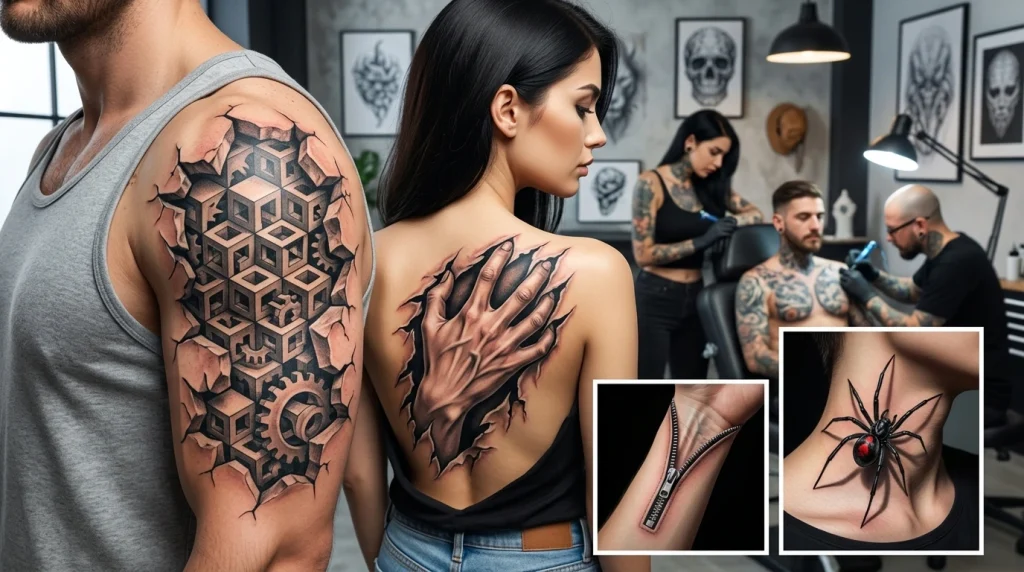
Redefining the Canvas with Depth
In the ever evolving world of body art, the line between the possible and the impossible is constantly being redrawn. Within the groundbreaking category of Innovative & Experimental Ink, 3D Illusion Tattoos stand as the pinnacle of technical deception. Unlike traditional tattoos that remain flat against the skin’s surface, these designs utilize advanced shading, strategic highlights, and hyper-realistic perspective to trick the human eye. Artists manipulate light and shadow with such surgical precision that the skin appears to warp, tear, or bulge, transforming the body into a living optical illusion where dragons seem to crawl out of open wounds or geometric portals appear to sink inches deep into the flesh.
The Science of the Sleight of Hand
Creating a convincing 3D tattoo requires a radical departure from conventional needle work. This experimental style demands a mastery of “trompe-l’œil” (deceive the eye) principles, where the artist must calculate a fixed point of view for the illusion to work correctly. Key techniques include soft black-and-grey realism to create gradients without outlines, strategic negative space to simulate reflected light, and the deliberate avoidance of solid black edges that would “flatten” the image. Many experimental artists are now incorporating skin-toned inks and even scarification textures to enhance the volumetric effect, making objects like zippers, bolts, or even water droplets appear physically tactile. The result is not merely a drawing on skin but a sculptural visual event that changes dramatically as the body moves.
The Artistic Risk and Reward
As a frontier of experimental ink, 3D illusion tattoos carry a unique set of challenges that push the boundaries of artistic trust. Unlike standard tattoos that look correct from all angles, these illusions often require the wearer to pose or position the body in a specific way to maintain the magic; viewing from the “wrong” angle collapses the effect, revealing the trick. This high-risk, high-reward nature makes them a favorite among collectors seeking novelty and shock value. From realistic bullet wounds that advocate for anti-violence campaigns to Escher-like impossible objects that celebrate mathematical art, these tattoos are a testament to how modern ink has evolved from decoration to a sophisticated, interactive visual performance that challenges our very perception of reality.
01. The “Skin Tear” Portal to Another Dimension
Breaking the Fourth Wall of the Body
Among the most visually arresting concepts in 3D Illusion Tattoos, the “Skin Tear” Portal to Another Dimension stands as a masterpiece of surreal storytelling. At first glance, the tattoo appears to show a violent yet precise rip in the wearer’s flesh complete with realistic shadows, curled skin flaps and subtle redness around the edges. But instead of revealing muscle or bone beneath, the tear opens into an entirely different world: a swirling galaxy, a bioluminescent jungle, a clockwork mechanism or even a glowing fantasy realm. This design hijacks the brain’s expectation of injury and replaces it with wonder, tricking the eye into believing the skin is merely a thin membrane separating our reality from another. It is not just a tattoo; it is a window painted onto the body.
The Technical Mastery Behind the Illusion
Creating a convincing Skin Tear Portal requires an exceptional level of technical skill in trompe l’œil (deceive the eye) techniques. The illusion hinges on three critical elements: edge shadowing, skin flap depth, and internal perspective. The tear’s edges must be rendered with a dark inner shadow fading into a crisp highlight on the raised “skin” border, mimicking how real wounds cast light. The peeled back flaps are shaded underneath with soft gradients to suggest they hover above the portal, not lie flat. Inside the opening, the artist uses forced perspective smaller, detailed elements near the center and larger ones near the rim to create a tunnel effect. Many experimental artists now layer UV-reactive inks inside the portal, so under blacklight, the hidden dimension glows with an impossible radiance, while the skin flaps remain dark, deepening the contrast between the real and the unreal.
Symbolism, Placement and Wearer Experience
Beyond its visual shock value, the Skin Tear Portal carries deep symbolic weight, making it a favorite among collectors who see their bodies as vessels for hidden worlds. The tear can represent escapism, inner duality, mental health journeys (a window into the subconscious) or grief and memory (a glimpse of a lost loved one’s realm). Placement is crucial for maintaining the illusion: flat, visible areas like the forearm, thigh, ribcage, or calf work best, as curved surfaces like the shoulder can distort the portal’s geometry. The wearer must accept a unique limitation the illusion is strongest from one primary viewing angle. Turn the arm too far and the “depth” collapses into a flat painting. This interactive fragility, however, becomes part of the art’s magic: it rewards the curious observer who takes the time to find the perfect line of sight. For those who dare, the Skin Tear Portal transforms their own flesh into a canvas where reality literally peels away to reveal the impossible.

02. Mechanical Gear Exposed Beneath Skin
The Body as a Living Machine
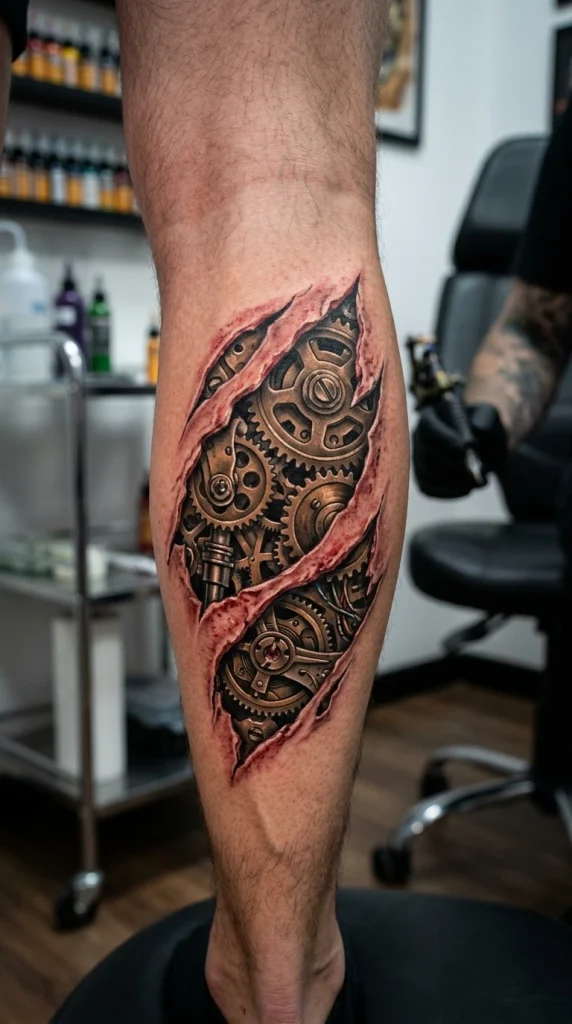
In the realm of 3D Illusion Tattoos, few concepts blur the line between organic and artificial as powerfully as The Mechanical Gear Exposed Beneath Skin. This design envisions a future where human flesh is merely a thin casing for精密 machinery. At first glance, the tattoo appears to show a realistic tear, incision, or worn away patch of skin. But instead of blood and tissue, the opening reveals a complex assembly of brass gears, steel pistons, copper wires and tiny rivets all rendered with such surgical precision that they seem to sit just millimeters below the surface. Some gears appear to be turning, suggested by subtle motion blur or overlapping shadows. The result is a startling fusion of steampunk aesthetics and biological realism, transforming the wearer into a cybernetic organism where muscle meets machine.
The Technical Art of Flesh and Metal
Creating a convincing Mechanical Gear Exposed tattoo demands mastery of both medical realism (for the skin opening) and industrial rendering (for the machinery). The illusion rests on four critical techniques. First, skin edge treatment: the torn or eroded flesh must have a thin, reddish pink border with subtle swelling highlights, mimicking healing tissue or recent trauma. Second, shadow layering: the gears cannot simply float they must cast deep, soft shadows onto the “floor” of the wound, while the overhanging skin flaps cast separate shadows onto the gears themselves. Third, metallic rendering: brass requires warm yellow brown highlights with crisp white catchlights; steel needs cool grays with sharp reflections. Finally, depth through blur: gears in the foreground are rendered sharply, while those deeper in the wound fade slightly in contrast, creating a true 3D cavity. Many experimental artists now use metallic inks (non toxic, iron oxide based) to add actual shimmer, and some even incorporate micro needling scarification around the edges to give the skin a slightly raised, healed scar texture.
Symbolism, Placement and Kinetic Experience
Beyond its visual impact, The Mechanical Gear Exposed carries rich symbolic meaning, making it a powerful choice for engineers, mechanics, steampunk enthusiasts, or anyone who identifies with resilience, precision or human augmentation. The exposed gears can represent the hidden workings of the mind (logic and emotion as interlocking cogs), the inevitability of aging (worn gears still turning) or transhumanist ideals of merging flesh with technology. Placement is crucial for maximizing the illusion. Ideal locations include joints the elbow, knee or wrist where natural bending creates a kinetic effect: as the wearer moves, the gears appear to shift and rotate relative to the viewer. Static placements like the forearm or calf work well for steady reveals, while the ribcage or collarbone offers a dramatic, hidden surprise. The wearer must accept that, like all 3D illusions, the effect is angle dependent; from the side, the gears may flatten. Yet this fragility becomes part of the narrative just as a machine reveals its inner workings only when opened, this tattoo offers its full magic only to those who look closely and from the right perspective.
03. Hyper Realistic Stitched Zipper
The Skin as a Concealable Surface
Among the most deceptively simple yet technically demanding designs in 3D Illusion Tattoos, The Hyper-Realistic Stitched Zipper transforms the human body into a living garment waiting to be unzipped. At first glance, the tattoo appears to show an actual metal zipper surgically sewn into the skin complete with individual teeth a dangling pull tab, and fabric-like stitching that puckers the surrounding flesh. Unlike the dramatic “skin tear” concept, the zipper does not necessarily reveal anything; its power lies in the anticipation of what lies beneath. Is the wearer hiding a second layer of skin? A different texture? A void? Or nothing at all? The zipper becomes a permanent invitation to the imagination, blurring the boundary between body and clothing, organic and manufactured. Some versions leave the zipper closed, creating tension through restraint, while others show it partially opened to reveal scales, fur, circuitry or a dark abyss.
The Precision Engineering of an Illusion
Creating a convincing Hyper Realistic Stitched Zipper demands obsessive attention to the smallest details as the human eye is exceptionally good at detecting flaws in familiar objects. The illusion rests on five critical techniques. First, individual tooth rendering: each metal tooth must have a dark shadow underneath, a bright highlight on top, and a tiny cast shadow onto the skin repeated dozens of times in perfect alignment. Second, the zipper tape: the fabric strip flanking the teeth requires a woven texture, achieved through fine parallel lines and subtle shading to mimic cloth. Third, suture realism: the stitches piercing the skin must show entry and exit holes, with slight skin indentation around each thread and tiny red inflammation dots for biological authenticity. Fourth, pull tab physics: the hanging tab must cast a dynamic shadow that changes direction relative to the zipper’s orientation and its metal surface needs a curved highlight to suggest three dimensional volume. Finally, skin interaction: the skin around the entire zipper should appear slightly stretched or puckered, as if the zipper was truly sewn under tension. Many experimental artists now use white ink highlights on every single tooth and stitch to create wet-looking specular shine and some incorporate micro scarification along the zipper track so the skin has a faintly raised, scar like texture that catches natural light.
Symbolism, Placement and Psychological Impact
The Hyper-Realistic Stitched Zipper carries profound symbolic weight, making it a favorite among collectors exploring themes of identity, concealment, vulnerability, and controlled revelation. For some, it represents emotional suppression keeping true feelings zipped shut. For others, it signifies recovery from trauma: the zipper as a scar that can be “opened” only when ready. In queer or body positive communities, it can celebrate the freedom to reveal one’s authentic self. Placement dramatically alters the meaning. A zipper down the spine suggests a hidden second self waiting to emerge. Across the chest over the heart implies protected emotions. On the inner wrist or behind the ear, it becomes an intimate secret. The back of the neck offers a shockingly realistic surprise when the wearer bends their head forward. The wearer must accept one limitation: like all 3D illusions, the zipper looks most convincing when viewed straight on. From extreme angles, the teeth may appear to flatten. Yet this imperfection echoes the tattoo’s theme some truths are only visible from the right perspective. For those who choose it, the stitched zipper turns their own skin into a question that will never be fully answered.

04. Water Drop on a Flower or Insect
The Poetry of Transient Realism
In the world of 3D Illusion Tattoos, where most concepts rely on drama tears, wounds, zippers or mechanical exposureThe Water Drop on a Flower or Insect stands apart through quiet, breathtaking subtlety. This design captures a fleeting moment of nature: a single, perfect droplet of water resting delicately on the velvety petal of a rose or the iridescent shell of a beetle. Unlike other illusions that scream for attention, the water drop whispers. It does not tear the skin or reveal hidden machinery; instead, it enhances what is already there the flower or insect beneath it appears magnified, slightly distorted and impossibly wet. The viewer’s brain struggles to accept that the droplet is permanent ink, not actual moisture waiting to roll off or evaporate. This is illusion as meditation, transforming the body into a dew-kissed morning garden frozen in time.
The Physics of Light Captured in Ink
Creating a convincing Water Drop tattoo is widely considered one of the most difficult challenges in 3D Illusion Tattoos, because the human eye is exquisitely sensitive to how real water behaves. The illusion rests on five non negotiable optical principles. First, the highlight: every real water droplet has a small, bright, crisp white reflection often crescent-shaped or circular where light hits the surface. Without this, the droplet looks like jelly or glass. Second, the cast shadow: the droplet must cast a soft, dark shadow on the petal or shell beneath it, opposite the highlight. Third, the refractive edge: the rim of the droplet bends light, so the underlying flower or insect pattern must appear slightly shifted, stretched or magnified inside the droplet’s body a technique called “caustic distortion.” Fourth, the contact line: where the droplet meets the surface, there must be a dark, thin meniscus shadow to suggest surface tension gripping the petal. Fifth, the transparency gradient: the center of the droplet should use minimal ink (often pure negative space of natural skin tone), while the edges darken gradually, simulating volume. Most experimental artists achieve this using soft black-and-grey washes for the droplet’s body, opaque white ink for the specular highlight and zero outlines any hard line would flatten the effect instantly. Some innovators now use glossy top coat sealants on the finished tattoo to add actual surface sheen, blurring the line between ink and reality.
Symbolism, Placement and Wearer Experience
The Water Drop on a Flower or Insect carries rich, layered symbolism that appeals to collectors drawn to nature, impermanence, clarity, and quiet beauty. The droplet can represent a tear of joy or sorrow a moment of pure observation, the fragility of life or the idea of seeing the world magnified through a single point of focus. On a flower, the drop evokes morning freshness, renewal, and the fleeting nature of beauty. On an insect especially a beetle or butterfly the drop suggests resilience: even the smallest creature carries its own world of moisture. Placement is critical for maximizing the illusion. Ideal locations include the collarbone (where natural shadows enhance depth), the shoulder (allowing the droplet to catch changing light as the arm moves), the back of the hand (where viewers instinctively expect moisture) or the ankle (a surprising, delicate placement). The tattoo works best on flatter, smooth skin areas with minimal hair, as hair disrupts the droplet’s clean edge. The wearer must accept a unique reality: the illusion is strongest under natural, directional light (sunlight or a single lamp). Under flat, diffuse lighting (overcast sky or fluorescent office lights), the droplet may appear less convincing. Yet this becomes part of the tattoo’s charm it rewards those who encounter the wearer in the right light, at the right angle, much like a real dewdrop that only sparkles when the sun hits it just so.

05. Bullet Impact with Cracked “Glass” Effect
Violence Transformed into Visual Poetry
Among the most dramatic and confrontational designs in 3D Illusion Tattoos, the Bullet Impact with Cracked “Glass” Effect replaces the expected imagery of bloody wounds with something far more unexpected and symbolic: a shattered pane of glass embedded directly into the skin. At first glance, the tattoo appears to show a high velocity impact point a dark, bruised epicenter surrounded by radiating fracture lines that spread outward like a spiderweb. But instead of torn flesh or exposed bone, the surface resembles tempered safety glass that has been struck but not yet collapsed. Tiny shards appear to peel slightly outward, catching light with razor sharp edges. Some versions include the faint reflection of an unseen face or environment in the intact portions of the “glass.” The result is a startling metaphor: the body as a fragile barrier between the self and external violence, where a bullet does not penetrate but instead leaves behind a cracked, glittering scar of arrested destruction.
The Physics of Fracture Rendered in Skin
Creating a convincing Bullet Impact with Cracked Glass tattoo demands an intimate understanding of how real brittle materials fail under stress, combined with advanced trompe l’œil shading techniques. The illusion rests on six critical elements. First, the impact epicenter: a dark, irregularly shaped core (often deep gray or bruised purple black) that represents the point of strike, with subtle concentric rings suggesting compression waves. Second, radial fracture lines: cracks must extend outward in straight, jagged paths that occasionally branch, never curving smoothly real glass fractures in straight lines. Each crack requires a double edge: a dark shadow on one side and a bright white highlight on the opposite side, simulating the raised, reflective edge of broken glass. Third, secondary stress fractures: smaller, thinner cracks that branch off the main lines, fading gradually into invisibility. Fourth, spall shards: tiny, detached glass fragments near the impact site, rendered with crisp white edges and dark undersides to suggest they are floating slightly above the skin. Fifth, the glass surface: large, intact areas between cracks must show faint, distorted reflections often a blurred suggestion of clouds, a window frame, or an abstract face created using soft gray washes with sharp white catchlights. Finally, skin interaction: the area beneath the “glass” requires a deep, dark shadow to suggest the glass is suspended above the skin, not lying flat. Some experimental artists now use negative space etching leaving fine, un-inked lines within the cracks to simulate light passing through actual gaps in shattered glass.
Symbolism, Placement and Emotional Weight
The Bullet Impact with Cracked Glass carries profound and often deeply personal symbolism, making it a powerful choice for survivors, advocates or anyone exploring themes of vulnerability, resilience, near misses and fragile strength. Unlike a realistic bullet wound tattoo (which can glorify violence), the cracked glass version transforms injury into a metaphor: the bullet struck, but the glass held. The wearer did not shatter. For survivors of gun violence, the tattoo can represent a literal or figurative “near miss.” For those struggling with mental health, it symbolizes the moment of crisis that cracks but does not break the psyche. For activists, it serves as a permanent conversation starter about gun safety, violence prevention, or personal boundaries. Placement dramatically affects meaning. Over the heart or chest speaks directly to emotional or physical survival. On the temple or forehead (extremely bold) suggests psychological resilience. The back of the hand or forearm offers high visibility for daily advocacy. The ribcage where real bullets often lodge adds anatomical authenticity. The wearer must accept two unique realities. First, the illusion requires consistent lighting to maintain the glass effect; direct overhead light flattens the cracks, while angled side light makes them “pop” with depth. Second, the tattoo invites questions. Strangers will ask, “Is that real glass?” and “What happened?” For those who wish to tell their story, this is a feature, not a flaw. For those who prefer privacy, the ambiguity of the image allows a simple answer: “It’s art.” Ultimately, the Bullet Impact with Cracked Glass turns the body into a monument not to violence itself, but to the moment violence failed to win.


