
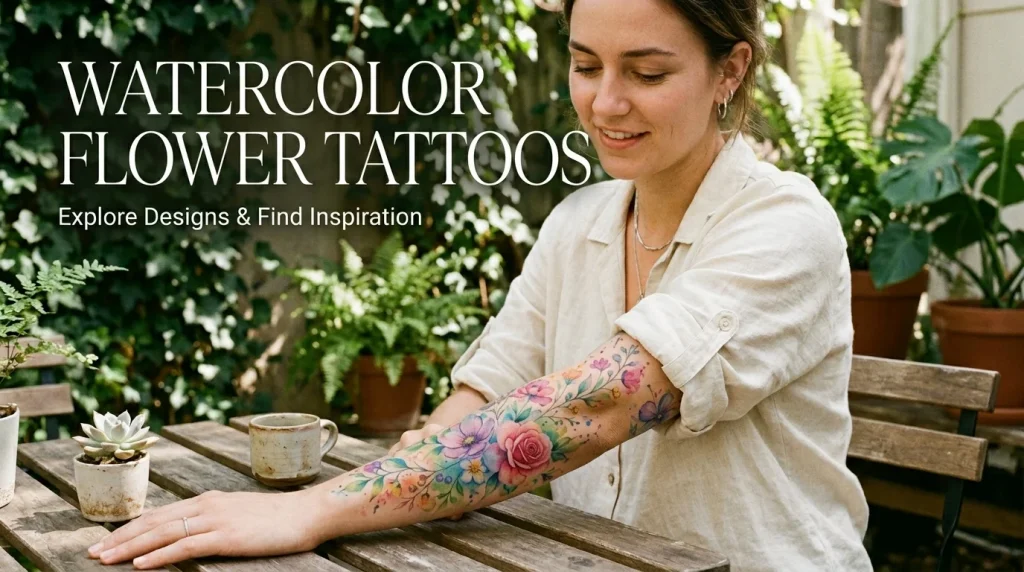
The Artistic Departure from Tradition
Within the expansive world of Floral & Feminine Designs, Watercolor Flower Tattoos represent a bold and poetic departure from traditional botanical illustration. Unlike classic styles that rely on bold black outlines and solid packing of color, this technique mimics the fluid, unpredictable nature of actual watercolor paintings on paper. Artists achieve this by using diluted inks, layered washes and controlled “spills” of pigment, allowing the flowers to appear as if they are blooming directly on the skin. This style prioritizes emotion over precision, capturing the delicate translucency of petals, the bleed of morning dew and the soft diffusion of light resulting in a design that feels more like a fine art canvas than a conventional tattoo.
The Aesthetic of Soft Blend and Movement
The signature allure of the watercolor flower lies in its soft blend painted aesthetic, which enhances the innate femininity of floral subjects. By eschewing harsh outlines, the petals seamlessly transition from saturated, deep hues at the center to barely tinted whispers of color at the edges, creating a dreamy, ethereal halo effect. Popular blooms like peonies, roses, lotus and cherry blossoms are ideal candidates as their natural layered structures lend themselves to gradients of magenta, lavender, coral and indigo. The technique also introduces organic movement suggesting wind or water through subtle “drips” and “splatters” that extend beyond the flower’s shape, turning each tattoo into a living, breathing impression of a garden in soft focus.
Feminine Expression and Modern Placement
This style has become a cornerstone of modern feminine expression due to its romantic vulnerability and artistic elegance. Because watercolor tattoos lack heavy linework, they are often designed to flow with the body’s natural contours, making them perfect for intimate or curved placements such as the forearm, ribs, collarbone, shoulder blade or trailing down the spine. They can be composed as standalone statement pieces a single, large hibiscus with bleeding edges or as gentle clusters that wrap around the wrist or ankle. While critics note that the soft edges may blur faster than traditional tattoos over time, skilled artists counteract this by choosing high contrast color palettes and leaving strategic “skin breaks” (negative space) to preserve legibility, ensuring that this painted floral art remains a timeless symbol of grace and creative spirit.
01. The Vine Embrace: Climbing Roses & Ivy
The Poetic Concept of Growth and Connection
The Vine Embrace is a watercolor tattoo design that captures the organic, untamed beauty of nature in motion. As part of the Floral & Feminine Designs collection, this piece features a sinuous vine of climbing roses and ivy that spirals gracefully around the limb typically from the ankle upward along the calf or from the wrist toward the elbow. The design tells a story of growth, resilience and gentle strength: the ivy represents fidelity and deep connection, while the climbing rose symbolizes passion, beauty and the reward of patience. Unlike static floral tattoos, The Vine Embrace moves with the body, appearing to grow naturally along the contours of the skin. Each twist of the vine reveals a new bloom or leaf, creating a continuous narrative that feels alive, feminine, and deeply personal. The wrap around format ensures that the tattoo is never fully visible from one angle alone it invites discovery, encouraging the viewer to see the artwork from every side, much like a real garden path.
The Watercolor Technique Soft Blends and Organic Bleeds
Executed in the signature watercolor style, The Vine Embrace abandons traditional black outlines in favor of soft, diffused washes of pigment that mimic the transparency of painted silk. The roses bloom in delicate shades of blush pink, dusty mauve and occasional soft coral, with their centers holding slightly more saturated tones while the outer petals fade into near invisibility. The ivy leaves shift from pale mint green near the vine’s base to deeper forest and sage green as they climb upward, creating a natural gradient that suggests sunlight filtering through foliage. Watercolor techniques such as wet on wet blending allow the pink of the roses to gently bleed into the green of adjacent leaves, evoking the way colors merge in a rainy garden. Controlled “drips” and tiny splatters of pigment trail along the vine’s path, mimicking morning dew or the gentle runoff of paint on paper. Negative space areas of bare skin left intentionally unpigmented acts as highlights, giving the petals and leaves a translucent, airy quality. This soft blend approach makes The Vine Embrace feel ethereal and romantic, far removed from the heavy, graphic look of traditional tattooing. However, skilled artists will strategically place slightly more saturated color in the vine’s core lines to help the design maintain its legibility over time as watercolor tattoos can soften further with age.
Feminine Placement, Symbolism and Lasting Appeal
The Vine Embrace is specifically designed to enhance the natural curves of the female body, making it a quintessential choice within the Floral & Feminine Designs category. Ideal placements include wrapping from the ankle to the mid calf (creating a “floral anklet” that climbs upward), spiraling around the forearm from wrist to elbow or tracing the curve of the ribs from front to back. For a bolder statement, the vine can extend from the foot, up the entire calf and end just below the knee a placement that elongates the leg visually and draws attention to the ankle’s delicate bone structure. The design is highly customizable in length and density: some clients prefer a sparse, minimalist vine with only a few roses scattered along a thin ivy tendril, while others choose a lush, abundant wrap with overlapping leaves and multiple full blooms. Symbolically, the combination of roses and ivy carries deep feminine meaning the rose speaks to love, passion, and inner beauty, while ivy represents loyalty, friendship and the enduring nature of emotional bonds. Together, they create a tattoo that honors both the fiery and the steadfast aspects of femininity. While watercolor tattoos require extra care (regular moisturizing and sun protection to prevent premature fading), The Vine Embrace’s flowing, organic design actually ages gracefully the natural blurring of edges over time only enhances its painted, impressionistic quality. For women seeking a tattoo that feels poetic, graceful and intimately connected to the body’s movement, The Vine Embrace offers a timeless celebration of nature’s most elegant forms.

02. The Flowing Sleeve: Peony & Wisteria Cascade
The Grandeur of a Cascading Botanical Sleeve
The Flowing Sleeve is a statement watercolor tattoo design that transforms the arm into a living canvas of cascading blooms and trailing vines. As part of the Floral & Feminine Designs collection, this piece features a dramatic yet graceful composition: a large, luminous peony positioned on the outer arm (either the shoulder/bicep or mid forearm), from which descends a waterfall of wisteria clusters that wrap around the inner arm and trail gracefully toward the elbow or wrist. Unlike traditional sleeve tattoos that rely on dense packing and heavy black outlines, The Flowing Sleeve embraces open space, movement, and transparency. The peony serves as the visual anchor bold, centered, and fully bloomed while the wisteria cascades outward like a botanical curtain, softening the transition from outer to inner arm. This wrap-around effect ensures that the tattoo tells a different story from every angle: from the front, you see the full glory of the peony; from the side, the wisteria’s graceful descent; from behind, the delicate fading of petals into scattered splatters. Designed for women who want a tattoo that feels luxurious, romantic, and undeniably feminine, The Flowing Sleeve mimics the elegance of a painted silk scarf draped over the arm.
The Watercolor Technique Layered Washes, Gradients and Soft Diffusion
Executed in the signature watercolor style, The Flowing Sleeve achieves its ethereal beauty through masterful manipulation of pigment dilution, layered washes and controlled bleeding. The peony, often rendered in warm coral, soft salmon pink and touches of golden amber, features saturated color at its dense inner petals that gradually diffuses into near transparency at the outer edges mimicking the way a real watercolor painting captures light passing through delicate petals. Artists achieve this by applying wet pigment onto a damp skin surface, allowing colors to merge organically without harsh lines. The wisteria clusters, painted in gradients of lavender, periwinkle, soft violet and pale lilac, hang in teardrop-like formations that blur at their tips, creating the illusion of raindrops or morning mist. A signature element of this design is the “cascade bleed”: where the wisteria meets the peony, the purples and pinks softly intermingle, creating a seamless transition between the two flowers. Tiny splatters and controlled “drips” of color magenta, violet and soft gold fall away from the main composition, mimicking the natural dispersal of pollen or the accidental beauty of paint splashed on paper. Negative space (un inked skin) plays a crucial role here: gaps between wisteria clusters allow the skin’s natural tone to act as a highlight, giving the tattoo an airy, breathable quality that prevents it from feeling heavy or overwhelming. To ensure longevity, skilled watercolor tattoo artists will anchor the design with subtle, broken lines of slightly more concentrated color along the peony’s inner petal folds and the wisteria stems, providing just enough structure without sacrificing the soft, outline free aesthetic.
Feminine Placement, Symbolic Depth and Customization Options
The Flowing Sleeve is designed to celebrate the natural curves and movement of the female arm, making it a quintessential choice within Floral & Feminine Designs. The most popular placement begins on the outer shoulder or upper bicep with the peony, then allows the wisteria to spiral diagonally across the inner forearm, ending just above the wrist. This placement elongates the arm visually and draws the eye along a graceful, flowing line. An alternative placement starts the peony on the outer forearm (just below the elbow) and cascades the wisteria toward the wrist and hand, creating a “draped” effect that feels delicate and refined. For a more dramatic interpretation, the design can be extended into a half-sleeve that wraps entirely around the arm, with the peony on the outer bicep and wisteria continuing around to the tricep and inner elbow. Symbolically, the peony holds deep feminine meaning: in Eastern traditions, it represents prosperity, honor, and romantic love, while in Victorian flower language, it signifies a happy marriage and bashfulness. The peony’s lush, layered petals also embody feminine beauty, compassion and the idea of “blooming into one’s fullest self.” Wisteria, with its cascading, pendulous clusters, symbolizes devotion, sensitivity and the beauty of letting go its downward flow represents graceful surrender and emotional depth. Together, they create a powerful narrative: the bold, confident bloom of the peony balanced by the soft, flowing vulnerability of wisteria. The design is highly customizable clients can choose peony colors ranging from classic pink to deep burgundy or even pale peach and wisteria hues from traditional purple to soft blue or blush lavender. Additional elements such as floating petals, gold watercolor splatters, or tiny ferns can be woven into the cascade. While watercolor tattoos require diligent sun protection and occasional touch ups to maintain their brilliance, The Flowing Sleeve’s inherently soft, blended style ages gracefully the gentle blurring over time only enhances its painted, impressionistic quality. For women seeking a tattoo that feels like wearable art elegant, emotional and effortlessly beautiful The Flowing Sleeve offers a timeless celebration of nature’s most poetic forms.

03. The Ribcage Drift: Cherry Blossom Vines
The Ethereal Poetry of Transient Beauty
The Ribcage Drift is a watercolor tattoo design that captures the delicate, fleeting beauty of cherry blossoms in gentle motion across one of the body’s most elegant contours. As part of the Floral & Feminine Designs collection, this piece features a thin, barely there vine of pale pink and soft white cherry blossoms that begins near the sternum, drifts sideways across the ribcage and wraps subtly toward the back, ending just before the spine. Unlike bold, densely packed floral tattoos, The Ribcage Drift embraces minimalism, breathability and the poetry of negative space. The design takes its name from the way the blossoms appear to drift as if carried by a soft spring breeze rather than being rigidly placed or structured. The ribcage placement is intentional and significant: as the wearer breathes, the blossoms subtly expand and contract with each inhale and exhale, making the tattoo feel truly alive. This interaction between art and anatomy transforms the design into a personal meditation on impermanence, renewal and the beauty of the present moment the very essence of cherry blossom symbolism in Japanese culture. For women seeking a tattoo that is intimate, whisper soft, and deeply meaningful without being overwhelming, The Ribcage Drift offers a perfect balance of visibility and privacy: visible when wearing a crop top, swimsuit or raised arms but easily concealed beneath clothing for professional or formal settings.
The Watercolor Technique Pale Washes, Cloud Like Blooms and Controlled Diffusion
Executed in the signature watercolor style, The Ribcage Drift achieves its signature ethereal quality through ultra diluted pigments, cloud-like petal formations and masterful control of color diffusion. Unlike watercolor tattoos that use saturated, vibrant hues, this design deliberately employs pale, translucent washes primarily soft blossom pink, whisper lavender, and creamy white that barely tint the skin, creating an effect reminiscent of cherry petals floating on a misty morning. The blossoms are not outlined or sharply defined; instead, each flower is suggested through clusters of tiny, blurred petal shapes where the pink gently bleeds outward into the surrounding skin, leaving soft, feathered edges that mimic the way light passes through real cherry petals. The vine itself is rendered as a thin, almost broken line of pale sepia or soft grey-brown, applied with such lightness that it appears to be drawn in diluted ink. Between the blossoms, the artist creates “drift marks” tiny splatters and isolated dots of pale pink and gold that trail away from the main flowers, suggesting petals that have broken free from the vine and are floating across the ribcage. A key technique in this design is the use of negative space (un inked skin) as an active compositional element: the blossoms are spaced apart with generous gaps, allowing the natural skin tone to act as the “sky” behind the drifting petals. To achieve the signature watercolor bleed, artists apply pigment to slightly dampened skin (using a distilled water spray), allowing the colors to spread organically before setting. This wet on wet technique creates the unpredictable, painterly blooms that define the style. However, because pale watercolor tattoos can fade more quickly than darker designs, skilled artists will often layer multiple translucent washes of the same color to build subtle depth without losing the airy quality and they may anchor each blossom with the tiniest concentration of pigment at its center just enough to preserve the flower’s identity as the tattoo ages.
Feminine Placement, Intimate Symbolism and Customization Nuances
The Ribcage Drift is specifically designed for one of the most feminine and sensitive areas of the body the lateral ribcage, extending from just below the breast to the waistline and from the sternum to the back. This placement offers several unique advantages: the natural curve of the ribs provides a gentle, undulating “canvas” that enhances the drifting, organic feel of the vines; the area’s relative lack of sun exposure (compared to arms or hands) helps preserve the delicate watercolor pigments longer; and the placement’s intimacy creates a personal connection between the wearer and the artwork. The design typically spans 4 to 8 inches in length, depending on the client’s anatomy and desired visibility. A shorter version might drift from the sternum to the outer ribcage (visible when wearing a V-neck or low-back top), while a longer version can wrap from the front ribs, under the arm, and end near the shoulder blade on the back (creating a beautiful surprise when seen from behind). Symbolically, cherry blossoms (sakura) carry profound meaning in both Eastern and Western traditions: they represent the transience of life (mono no aware), the bittersweet beauty of fleeting moments, renewal, hope and the gentle strength found in vulnerability. When placed on the ribcage close to the heart and lungs the design takes on additional layers of meaning: each breath becomes a reminder to cherish the present moment, and the heart’s proximity to the blossoms symbolizes love that is delicate yet enduring. The Ribcage Drift can be customized in several meaningful ways: clients may choose to add a single darker blossom (deep magenta or crimson) to represent a loved one, incorporate tiny gold leaf accents for a touch of luminosity or integrate a few falling petals that extend toward the heart. Some women opt to include a thin line of Japanese calligraphy a single word like “sakura” (cherry blossom), “yume” (dream) or “hakanashi” (ephemeral) woven subtly into the vine. Because ribcage tattooing is known to be more painful due to thin skin and proximity to bone, The Ribcage Drift’s light-handed, minimalist approach requires less needle trauma than dense tattoos, making the experience more manageable. Aftercare is crucial: clients must be diligent about sunscreen application if wearing open sided tops and occasional touch ups every 3 – 5 years may be needed to refresh the pale pigments. However, many women find that the natural softening of the design over time only enhances its dreamy, ephemeral quality the blossoms gradually becoming more like a cherished memory than a sharp tattoo. For the woman who wants her body art to feel like a secret poem a spring morning or a gentle exhale, The Ribcage Drift offers an exquisitely feminine tribute to life’s most beautiful, fleeting moments.

04. The Wrist to Shoulder: Lotus & Water Lily Wrap
The Journey of Growth Along the Arm
The Wrist to Shoulder Wrap is a watercolor tattoo design that transforms the entire arm into a narrative of spiritual awakening and feminine grace. As part of the Floral & Feminine Designs collection, this piece features a continuous, flowing composition that begins as a tiny, closed lotus bud on the inner wrist, gradually expands into a fully blooming water lily on the mid forearm and then transitions into floating petals and abstract aquatic washes that spiral around the elbow and fade into the inner bicep or shoulder. Unlike static, standalone floral tattoos, this design tells a story of ascent from the contained potential of the wrist to the full, open expression near the heart. The wrap around nature is essential to its beauty: the design is never fully visible from any single angle, revealing new petals, new color blends, and new dimensions with every turn of the arm. This creates an interactive, intimate experience both for the wearer, who can admire different sections throughout the day, and for observers, who discover the tattoo gradually rather than all at once. The lotus and water lily, both aquatic flowers that emerge from muddy waters to bloom unblemished, carry deep symbolism of purity, resilience and enlightenment. By placing their journey along the arm from the hand (action) to the shoulder (strength) and heart the design becomes a wearable metaphor for personal growth, emotional healing, and the realization of one’s fullest, most beautiful self.
The Watercolor Technique Transitional Gradients, Aquatic Washes and Spiral Movement
Executed in the signature watercolor style, The Wrist to Shoulder Wrap achieves its mesmerizing effect through carefully orchestrated color transitions, fluid aquatic washes and a spiral composition that guides the eye along the arm’s natural contours. The design begins at the wrist with the smallest elements: a tightly curled lotus bud in pale, almost translucent pink and soft mint green, rendered with minimal pigment and maximum negative space to suggest new beginnings and quiet potential. As the composition moves up the forearm, the colors gradually deepen and expand the pale pink shifts to coral and soft rose, the mint green transitions into deeper seafoam and jade. The mid forearm features the first fully open water lily, its layered petals painted with wet on wet watercolor techniques that allow the pinks, corals and touches of warm yellow at the center to bleed softly into one another, creating a luminous, almost glowing effect. The elbow area serves as the design’s dramatic turning point: here, the flowers begin to dissolve into abstract washes of aquamarine, soft indigo and lavender mimicking the way water lilies float on a pond’s surface. Tiny splatters and controlled “drips” of blue and violet trail around the elbow, suggesting water droplets or the gentle ripple of a lily pad. As the composition continues to the inner bicep and shoulder, the flowers become increasingly sparse and ethereal, with isolated petals drifting upward like they are being carried by a gentle current. A signature technique in this design is the use of “water blooms” intentional areas where the pigment pools and dries with a darker edge and lighter center, mimicking the natural rings left by evaporating watercolor on paper. To create the wrap around effect, the artist carefully maps the design to the arm’s three dimensional surface, ensuring that key flowers are visible from the front, sides and back. Negative space (un inked skin) plays a crucial role, particularly between the elbow and shoulder, where bare skin acts as the “water surface” against which the floating petals are silhouetted. Because this design spans a large area and involves multiple color transitions, skilled watercolor tattoo artists will often complete it over two or three sessions, allowing each section to heal before blending seamlessly into the next. To ensure longevity, the anchor points the lotus bud’s core, the water lily’s center and the densest petal clusters receive slightly more saturated pigment, providing visual anchors that will remain legible as the softer edges naturally blur over time.
Feminine Placement, Symbolic Depth and Customization Pathways
The Wrist to Shoulder Wrap is designed specifically for the female arm, celebrating its length, curvature, and expressive potential as a canvas for wearable art. The most popular placement begins on the inner wrist (just above the wrist bone), spirals diagonally across the inner forearm, wraps around the elbow (with the design crossing the outer elbow or staying on the inner side based on pain tolerance) and ends on the inner bicep or the front of the shoulder. This pathway follows the natural lines of the arm, elongating its appearance and drawing attention to the wrist’s delicacy and the shoulder’s strength. An alternative placement begins on the outer wrist, wraps across the top of the forearm and ends on the outer bicep and shoulder cap a bolder option that is more visible when wearing sleeveless tops. For a more extensive commitment, the design can continue from the shoulder across the collarbone or down the upper back, transforming into a full botanical half sleeve. Symbolically, the lotus and water lily carry profound feminine and spiritual meanings across multiple cultures. In Buddhism and Hinduism, the lotus represents enlightenment, purity of mind and spirit and the ability to rise above suffering its roots in muddy water, its stem growing through murky depths, and its flower blooming immaculate above the surface. The water lily, particularly the blue water lily (Nymphaea caerulea), was sacred in ancient Egyptian culture, symbolizing rebirth, the sun’s journey and the feminine divine. Together, the two flowers create a layered narrative: the lotus speaks to spiritual discipline and inner transformation, while the water lily represents emotional healing, sensuality and the beauty of floating with life’s currents. The wrist to shoulder journey adds another dimension: the wrist (associated with action, writing and reaching outward) holds the closed bud of potential; the forearm (daily tasks, giving and receiving) holds the opening flower; the elbow (flexibility and change) holds the abstract, dissolving forms and the shoulder (burden bearing and embracing) holds the final, floating petals near the heart. This anatomical narrative transforms the tattoo into a personal meditation on the wearer’s own journey whether recovering from hardship, celebrating personal growth or simply honoring the continuous process of becoming. Customization options are extensive: clients can choose color palettes ranging from traditional pink lotus and white water lily to more unusual combinations like purple lotus with turquoise water lily or even monochromatic blue and silver for a moonlit effect. Additional elements can be woven into the design tiny lily pads, koi fish swimming between flowers, floating water droplets or subtle geometric mandalas behind the blossoms. Some women incorporate meaningful dates, initials or short mantras written in thin, watercolor bleeding calligraphy along the vine. Because the arm receives moderate sun exposure, diligent aftercare including high SPF sunscreen whenever the arm is uncovered is essential to preserve the delicate watercolor pigments. Touch ups every 3 to 5 years may be needed, particularly on the wrist and elbow areas where skin moves and sheds more frequently. However, many women find that the natural softening of the design over time enhances its dreamy, aquatic quality the edges blurring like a memory of flowers floating on water. For the woman who wants her tattoo to be a daily reminder of her own resilience, beauty and continuous evolution, The Wrist to Shoulder Wrap offers an exquisitely feminine and deeply spiritual celebration of the journey from the depths to the light.

05. The Thigh Garland: Wildflower Meadow Wrap
The Romantic Abundance of a Summer Meadow
The Thigh Garland is a watercolor tattoo design that captures the joyful, untamed spirit of a wildflower meadow in full bloom. As part of the Floral & Feminine Designs collection, this piece features a loose, irregular garland of mixed wildflowers cornflowers in soft blue, poppies in translucent orange, baby’s breath in pale grey lavender, buttercups in warm yellow, and delicate clusters of forget me nots that wraps gracefully around the upper thigh, resting just below the hip. Unlike structured, symmetrical floral tattoos that feel formal and arranged, The Thigh Garland embraces the organic chaos of nature: flowers cluster densely on the outer thigh where the meadow would receive the most sun, then drift apart and fade into scattered dots, splatters, and isolated petals as they cross the inner thigh. The wrap around effect is essential to its charm the garland never forms a complete, closed circle but rather a crescent like embrace that begins near the front of the hip, dips down across the outer thigh, and trails off toward the back, leaving the inner thigh mostly bare for a sensual, airy finish. This placement is both playful and intimate: visible when wearing shorts, a swimsuit or a high slit skirt, yet easily concealed beneath longer hemlines. The Thigh Garland speaks to the woman who loves the outdoors, values freedom over perfection and wants a tattoo that feels like a permanent celebration of summer a field of flowers she carries with her everywhere, blooming anew each time she reveals them.
The Watercolor Technique Impressionistic Blooms, Translucent Layers and Meadow Splatters
Executed in the signature watercolor style, The Thigh Garland achieves its signature meadow-like quality through impressionistic flower forms, multiple translucent layers of color and an abundance of organic splatters that mimic pollen, dew, and scattered seeds. Unlike watercolor tattoos that focus on one or two large, detailed flowers, this design features dozens of small, loosely painted blooms, each suggested rather than perfectly rendered. The cornflowers appear as soft blue bursts with feathered, blurry edges, created by applying concentrated pigment to damp skin and allowing it to bloom outward naturally. The poppies are painted in thin, transparent washes of orange and coral, with their centers left as negative space (un-inked skin) to suggest the flower’s dark core without using black ink. Baby’s breath is rendered as clusters of tiny grey lavender dots and dashes, so delicate that they appear to float just above the skin’s surface. Buttercups add small pops of warm yellow, applied with a dry brush technique that leaves streaky, textured marks resembling the way sunlight catches glossy petals. A signature element of this design is the “meadow floor” the spaces between flowers are not left empty but are filled with a soft, abstract wash of pale green and golden yellow, barely visible but present enough to suggest grass and sunlight. This wash is applied with a large, soft mag needle in wide, sweeping strokes, creating a subtle background that unifies the composition. The wrap around effect is enhanced by “drift trails” clusters of tiny splatters, isolated petals and single dots of color that extend beyond the main garland, mimicking the way wind carries seeds and pollen across a field. To achieve the impressionistic, slightly out of focus look, artists use a combination of wet on wet blending (for soft, bleeding edges) and dry brush stippling (for textured, speckled areas). Because the thigh is a large, relatively flat canvas with good blood flow, healing is typically straightforward, though the inner thigh’s thinner skin and potential for friction require careful aftercare. To ensure the design remains readable over time, skilled watercolor artists will anchor the composition with slightly more saturated color in the densest flower clusters (typically the outer thigh poppies and cornflowers), while allowing the more delicate elements to remain intentionally faint, understanding that they may soften further with age.
Feminine Placement, Symbolic Abundance and Meadow Inspired Customization
The Thigh Garland is specifically designed for the upper thigh one of the most feminine, powerful, and sensuous areas of the female body. This placement offers several unique advantages: the thigh’s large surface area allows for an expansive, meadow like composition that would feel crowded on smaller body parts; the natural curve of the outer thigh provides a beautiful “drape” for the garland to follow; the area’s relative privacy creates an intimate connection between the wearer and her tattoo; and the thigh’s strength and mobility used for walking, running, dancing makes the flowers feel alive and in motion. The design typically wraps from the front hip bone (anterior superior iliac spine), diagonally across the outer thigh and ends near the gluteal fold or upper hamstring on the back of the leg. A shorter version might span 6 to 8 inches, while a more extensive wrap can cover 12 to 14 inches, reaching from the hip to mid thigh. The garland sits approximately 2 to 4 inches below the hip crease, ensuring it remains visible above shorts or a bikini bottom without being obscured by undergarment lines. Symbolically, wildflowers carry meanings vastly different from cultivated garden flowers they represent freedom, resilience, natural beauty and the ability to thrive without pruning, planning, or permission. Each flower in the meadow adds its own layer of meaning: cornflowers (blue) symbolize delicacy and hope; poppies (orange/red) represent imagination, dreams, and remembrance; baby’s breath (grey-lavender) signifies everlasting love and pure heart; buttercups (yellow) bring joy, playfulness and childhood nostalgia; forget me nots (blue with yellow centers) speak to true love and faithful memory. Together, they form a garland that celebrates the wearer’s multifaceted nature her dreams, her joys, her loves, her resilience. The thigh placement adds another dimension: the thigh is associated with strength, movement and the ability to stand firm in one’s beliefs. A wildflower meadow on the thigh thus becomes a declaration that the wearer’s strength is not rigid or harsh but soft, blooming and deeply connected to the natural world. Customization options are nearly endless. Clients can choose a seasonal meadow: spring (tulips, daffodils, crocuses in pastels), summer (poppies, cornflowers, daisies in brights), or autumn (goldenrod, aster, black eyed Susans in warm ambers and purples). Regional wildflowers can be incorporated California poppies, Texas bluebonnets, English cowslips or Japanese ajisai (hydrangeas). Some women add meadow creatures: a tiny watercolor bee, a hovering hummingbird or a resting butterfly. Others incorporate meaningful elements like a winding path through the flowers, a crescent moon hovering above or a line of poetry written in bleeding ink. For a more abstract interpretation, the flowers can gradually dissolve into watercolor splatters and washes toward the inner thigh, creating a sensual fade that draws the eye. Aftercare is particularly important for the inner thigh area, which experiences friction from walking and clothing clients are advised to wear loose, breathable fabrics during healing and to avoid high impact activities for the first week. Sun protection is essential as the thighs are often exposed during summer months and UV exposure will fade watercolor pigments more quickly than traditional tattoo inks. However, many women find that the natural softening of The Thigh Garland over time only enhances its meadow like quality the edges blur like wildflowers seen through warm summer haze and the scattered splatters become more integrated with the skin. For the woman who wants her tattoo to feel like a secret garden, a celebration of summer or a permanent reminder of her own untamed, blooming spirit, The Thigh Garland offers an exquisitely feminine and joyfully abundant tribute to the beauty of growing wild.

